

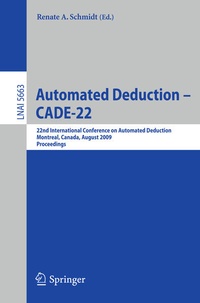
Automated Deduction - CADE-22
22nd International Conference on Automated Deduction, Montreal, Canada, August 2-7, 2009. Proceedings
Published on 10. July 2009
Book
Paperback/Softback
XIV, 504 pages
978-3-642-02958-5 (ISBN)
Description
This volume contains the proceedings of the 22nd International Conference on Automated Deduction (CADE-22). The conference was hosted by the School of Computer Science at McGill University, Montreal, Canada, during August 2-7, 2009. CADE is the major forum for the presentation of research in all aspects of automated deduction. Within this general topic the conference is devoted to foundations, applications, implementations and practical experiences. CADE was founded in 1974 when it was held in Argonne, USA. Since then CADE has been organized ?rst on a bi-annual basis mostly and since 1996 on an annual basis, in 2001, 2004, 2004, 2006 and 2008 as a constituent of IJCAR. This year the Program Committee selected 32 technical contributions out of 77 initial submissions. Of the selected papers 27 were regular papers and 5 were system papers. Each paper was refereed by at least three reviewers on its sign- icance, technical quality, originality, quality of presentation and relevance to the conference. The refereeing process and the Program Committee meeting were conducted electronically via the Internet using the EasyChair conference m- agement system.
The program included three invited lectures by distinguished experts in the area: Instantiation-Based Automated Reasoning: From Theory to Practice by Konstantin Korovin(The Universityof Manchester,UK),Integrated Reasoning and Proof Choice Point Selection in the Jahob System: Mechanisms for Program Survival by Martin Rinard (Massachusetts Institute of Technology, USA),and Building Theorem Provers byMarkStickel(SRIInternational,USA).
The program included three invited lectures by distinguished experts in the area: Instantiation-Based Automated Reasoning: From Theory to Practice by Konstantin Korovin(The Universityof Manchester,UK),Integrated Reasoning and Proof Choice Point Selection in the Jahob System: Mechanisms for Program Survival by Martin Rinard (Massachusetts Institute of Technology, USA),and Building Theorem Provers byMarkStickel(SRIInternational,USA).
More details
Series
Edition
2009 ed.
Language
English
Place of publication
Berlin
Germany
Publishing group
Springer Berlin
Target group
Professional and scholarly
Illustrations
XIV, 504 p.
Dimensions
Height: 235 mm
Width: 155 mm
Thickness: 28 mm
Weight
779 gr
ISBN-13
978-3-642-02958-5 (9783642029585)
DOI
10.1007/978-3-642-02959-2
Schweitzer Classification
Content
Session 1. Invited Talk.- Integrated Reasoning and Proof Choice Point Selection in the Jahob System - Mechanisms for Program Survival.- Session 2. Combinations and Extensions.- Superposition and Model Evolution Combined.- On Deciding Satisfiability by DPLL( ) and Unsound Theorem Proving.- Combinable Extensions of Abelian Groups.- Locality Results for Certain Extensions of Theories with Bridging Functions.- Session 3. Minimal Unsatisfiability and Automated Reasoning Support.- Axiom Pinpointing in Lightweight Description Logics via Horn-SAT Encoding and Conflict Analysis.- Does This Set of Clauses Overlap with at Least One MUS?.- Progress in the Development of Automated Theorem Proving for Higher-Order Logic.- Session 4. System Descriptions.- System Description: H-PILoT.- SPASS Version 3.5.- Dei: A Theorem Prover for Terms with Integer Exponents.- veriT: An Open, Trustable and Efficient SMT-Solver.- Divvy: An ATP Meta-system Based on Axiom Relevance Ordering.- Session 5. Invited Talk.- Instantiation-Based Automated Reasoning: From Theory to Practice.- Session 6. Interpolation and Predicate Abstraction.- Interpolant Generation for UTVPI.- Ground Interpolation for Combined Theories.- Interpolation and Symbol Elimination.- Complexity and Algorithms for Monomial and Clausal Predicate Abstraction.- Session 7. Resolution-Based Systems for Non-classical Logics.- Efficient Intuitionistic Theorem Proving with the Polarized Inverse Method.- A Refined Resolution Calculus for CTL.- Fair Derivations in Monodic Temporal Reasoning.- Session 8. Termination Analysis and Constraint Solving.- A Term Rewriting Approach to the Automated Termination Analysis of Imperative Programs.- Solving Non-linear Polynomial Arithmetic via SAT Modulo Linear Arithmetic.- Session 9. Invited Talk.-Building Theorem Provers.- Session 10. Rewriting, Termination and Productivity.- Termination Analysis by Dependency Pairs and Inductive Theorem Proving.- Beyond Dependency Graphs.- Computing Knowledge in Security Protocols under Convergent Equational Theories.- Complexity of Fractran and Productivity.- Session 11. Models.- Automated Inference of Finite Unsatisfiability.- Decidability Results for Saturation-Based Model Building.- Session 12. Modal Tableaux with Global Caching.- A Tableau Calculus for Regular Grammar Logics with Converse.- An Optimal On-the-Fly Tableau-Based Decision Procedure for PDL-Satisfiability.- Session 13. Arithmetic.- Volume Computation for Boolean Combination of Linear Arithmetic Constraints.- A Generalization of Semenov's Theorem to Automata over Real Numbers.- Real World Verification.