

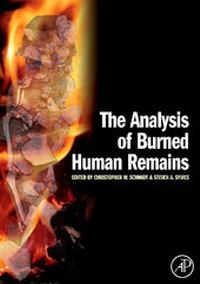
The Analysis of Burned Human Remains
Published on 29. January 2008
Book
Hardback
296 pages
978-0-12-372510-3 (ISBN)
Description
This unique reference provides a primary source for osteologists and the medical/legal community for the understanding of burned bone remains in forensic or archaeological contexts. It describes in detail the changes in human bone and soft tissues as a body burns at both the chemical and gross levels and provides an overview of the current procedures in burned bone study. Case studies in forensic and archaeological settings aid those interested in the analysis of burned human bodies, from death scene investigators, to biological anthropologists looking at the recent or ancient dead.
More details
Language
English
Place of publication
San Diego
United States
Publishing group
Elsevier Science Publishing Co Inc
Target group
Professional and scholarly
Researchers in bone biology, forensic anthropology, and endocrinology
Dimensions
Height: 260 mm
Width: 184 mm
Weight
810 gr
ISBN-13
978-0-12-372510-3 (9780123725103)
Copyright in bibliographic data and cover images is held by Nielsen Book Services Limited or by the publishers or by their respective licensors: all rights reserved.
Schweitzer Classification
Other editions
New editions
Christopher W. Schmidt | Steven A. Symes
The Analysis of Burned Human Remains
Book
06/2015
2nd Edition
Academic Press
€92.50
Shipment within 15-20 days
Additional editions
Christopher W. Schmidt | Steven A. Symes
The Analysis of Burned Human Remains
E-Book
10/2011
Academic Press
€118.00
Available for download
Persons
A U.S. forensic anthropologist best known for his expertise in interpreting trauma to bone and a leading authority on saw and knife mark analysis. With 30 years of experience, he has assisted federal, state, local, and international authorities in the identification and analysis of human remains. A sought-after consultant in criminal cases, Dr. Symes has been qualified as an expert for both the prosecution and defense, testifying specifically on forensic tool mark and fracture pattern interpretation in bone, as well as blunt force, ballistic, burned and healing trauma in bone. Certified by the American Board of Forensic Anthropology and recently retired from the Board of Directors, Dr. Symes has lectured, consulted or testified on trauma cases, among them high-profile human rights cases, in the United States, Canada, Mexico, Peru, El Salvador, Indonesia, Kosovo, South Africa and Europe. In addition, he has authored more than 50 publications and delivered over 100 papers, lectures and workshops on a variety of forensic anthropology topics. He is co-editor of The Analysis of Burned Human Remains, Second Edition published by Elsevier / Academic Press.
Content
1. Fire and Bodies
2. Patterned Thermal Destruction of Human Remains in a Forensic Setting
3. The Recovery and Study Of Burned Human Teeth
4. Analysis of Human Cremains: Gross and Chemical Methods
5. Thermally Induced Changes in the Stable Carbon and Nitrogen Isotope Ratios of Charred Bones
6. Bone Color as an Interpretive Tool of the Depositional History of Archaeological Cremains
7. Time, Temperature, and Oxygen Availability: An Experimental Study of the Effects of Environmental Conditions on the Color and Organic Content of Cremated Bone
8. Heat-Related Changes in Tooth Color: Temperature Versus Duration of Exposure
9. Investigations on Pre-Roman and Roman cremation Remains from Southwestern Germany: Results, Potentialities and Limits
10. In the Heat of the Pyre: Efficiency of Oxidation in Romano-British Cremations - Did it Really Matter?
11. Fire as a Cultural Taphonomic Agent: Understanding Mortuary Behavior at Khuzhir-Nuge XIV, Siberia
12. Putting Together the Pieces: Reconstructing Mortuary Practices from Commingled Ossuary Cremains
13. A Taphonomic Analysis of Human Cremains from the Fox Hollow farm Serial Homicide Site
14. Early Archaic Cremations from Southern Indiana
15. Towards an Archaeology of Cremation
2. Patterned Thermal Destruction of Human Remains in a Forensic Setting
3. The Recovery and Study Of Burned Human Teeth
4. Analysis of Human Cremains: Gross and Chemical Methods
5. Thermally Induced Changes in the Stable Carbon and Nitrogen Isotope Ratios of Charred Bones
6. Bone Color as an Interpretive Tool of the Depositional History of Archaeological Cremains
7. Time, Temperature, and Oxygen Availability: An Experimental Study of the Effects of Environmental Conditions on the Color and Organic Content of Cremated Bone
8. Heat-Related Changes in Tooth Color: Temperature Versus Duration of Exposure
9. Investigations on Pre-Roman and Roman cremation Remains from Southwestern Germany: Results, Potentialities and Limits
10. In the Heat of the Pyre: Efficiency of Oxidation in Romano-British Cremations - Did it Really Matter?
11. Fire as a Cultural Taphonomic Agent: Understanding Mortuary Behavior at Khuzhir-Nuge XIV, Siberia
12. Putting Together the Pieces: Reconstructing Mortuary Practices from Commingled Ossuary Cremains
13. A Taphonomic Analysis of Human Cremains from the Fox Hollow farm Serial Homicide Site
14. Early Archaic Cremations from Southern Indiana
15. Towards an Archaeology of Cremation