

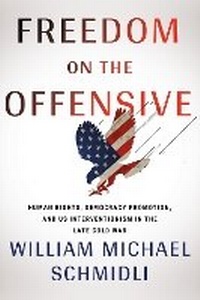
Freedom on the Offensive
Human Rights, Democracy Promotion, and US Interventionism in the Late Cold War
Published on 15. September 2022
Book
Hardback
324 pages
978-1-5017-6514-8 (ISBN)
Description
In Freedom on the Offensive, William Michael Schmidli illuminates how the Reagan administration's embrace of democracy promotion was a defining development in US foreign relations in the late twentieth century. Reagan used democracy promotion to refashion the bipartisan Cold War consensus that had collapsed in the late 1960s amid opposition to the Vietnam War. Over the course of the 1980s, the initiative led to a greater institutionalization of human rights-narrowly defined to include political rights and civil liberties and to exclude social and economic rights-as a US foreign policy priority. Democracy promotion thus served to legitimize a distinctive form of US interventionism and to underpin the Reagan administration's aggressive Cold War foreign policies. Drawing on newly available archival materials, and featuring a range of perspectives from top-level policymakers and politicians to grassroots activists and militants, this study makes a defining contribution to our understanding of human rights ideas and the projection of American power during the final decade of the Cold War.
Using Reagan's undeclared war on Nicaragua as a case study in US interventionism, Freedom on the Offensive explores how democracy promotion emerged as the centerpiece of an increasingly robust US human rights agenda. Yet, this initiative also became intertwined with deeply undemocratic practices that misled the American people, violated US law, and contributed to immense human and material destruction. Pursued through civil society or low-cost military interventions and rooted in the neoliberal imperatives of US-led globalization, Reagan's democracy promotion initiative had major implications for post-Cold War US foreign policy.
Using Reagan's undeclared war on Nicaragua as a case study in US interventionism, Freedom on the Offensive explores how democracy promotion emerged as the centerpiece of an increasingly robust US human rights agenda. Yet, this initiative also became intertwined with deeply undemocratic practices that misled the American people, violated US law, and contributed to immense human and material destruction. Pursued through civil society or low-cost military interventions and rooted in the neoliberal imperatives of US-led globalization, Reagan's democracy promotion initiative had major implications for post-Cold War US foreign policy.
Reviews / Votes
When William Michael Schmidli writes about Reagan's policies, he sounds like a Reaganite. And when he writes about Nicaragua, he sounds like a Sandinista. Some may find this unsettling. I take it to be one of his strengths as a historian.(Hispanic American Historical Review)
More details
Series
Language
English
Place of publication
Ithaca
United States
Product notice
Paper over boards
Dimensions
Height: 229 mm
Width: 152 mm
Thickness: 28 mm
Weight
907 gr
ISBN-13
978-1-5017-6514-8 (9781501765148)
Copyright in bibliographic data and cover images is held by Nielsen Book Services Limited or by the publishers or by their respective licensors: all rights reserved.
Schweitzer Classification
Other editions
Additional editions

William Michael Schmidli
Freedom on the Offensive
Human Rights, Democracy Promotion, and US Interventionism in the Late Cold War
E-Book
09/2022
Cornell University Press
€35.99
Available for download
Person
William Michael Schmidli teaches at the Institute for History at Leiden University. He is the author of The Fate of Freedom Elsewhere.
Content
Introduction: "The Most Important Place in the World": The Reagan Administration, Democracy Promotion, and the Nicaraguan Revolution
1. Competing Visions: Human Rights and American Foreign Policy in the Era of Detente, 1968-1980
2. "A Hostile Takeover": The Reagan Administration and U.S. Cold War Policy, 1981-1982
3. "Is This Not Respect for Human, Economic, and Social Rights?": Nicaragua and the United States, 1979-1984
4. "Global Revolution": The Ascendance of Democracy Promotion in U.S. Foreign Policy, 1982-1986
5. Tracking the "Indiana Jones of the Right": Right-Wing Transnational Activism, Public Diplomacy, and the Reagan Doctrine, 1981-1990
6. "The Grindstone on Which We Sharpen Ourselves": Solidarity Activism and the U.S. War on Nicaragua, 1981-1990
7. From the Cold War to the End of History: U.S. Democracy Promotion, Interventionism, and Unipolarity, 1987-1990
Conclusion: The Reagan Imprint: Democracy Promotion in U.S. Foreign Relations After the Cold War
1. Competing Visions: Human Rights and American Foreign Policy in the Era of Detente, 1968-1980
2. "A Hostile Takeover": The Reagan Administration and U.S. Cold War Policy, 1981-1982
3. "Is This Not Respect for Human, Economic, and Social Rights?": Nicaragua and the United States, 1979-1984
4. "Global Revolution": The Ascendance of Democracy Promotion in U.S. Foreign Policy, 1982-1986
5. Tracking the "Indiana Jones of the Right": Right-Wing Transnational Activism, Public Diplomacy, and the Reagan Doctrine, 1981-1990
6. "The Grindstone on Which We Sharpen Ourselves": Solidarity Activism and the U.S. War on Nicaragua, 1981-1990
7. From the Cold War to the End of History: U.S. Democracy Promotion, Interventionism, and Unipolarity, 1987-1990
Conclusion: The Reagan Imprint: Democracy Promotion in U.S. Foreign Relations After the Cold War