

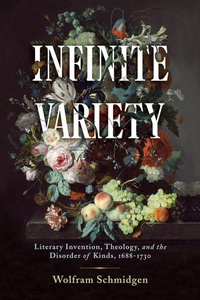
Infinite Variety
Literary Invention, Theology, and the Disorder of Kinds, 1688-1730
Published on 13. August 2021
Book
Hardback
288 pages
978-0-8122-5329-0 (ISBN)
Description
Unnerved by the upheavals of the seventeenth century, English writers including Thomas Hobbes, Richard Blackmore, John Locke, Jonathan Swift, and Daniel Defoe came to accept that disorder, rather than order, was the natural state of things. They were drawn to voluntarism, a theology that emphasized a willful creator and denied that nature embodied truth and beauty. Voluntarism, Wolfram Schmidgen contends, provided both theological framework and aesthetic license. In Infinite Variety, he reconstructs this voluntarist tradition of literary invention.
Once one accepted that creation was willful and order arbitrary, Schmidgen argues, existing hierarchies of kind lost their normative value. Literary invention could be radicalized as a result. Acknowledging that the will drives creation, such writers as Blackmore and Locke inverted the rules of composition and let energy dominate structure, matter create form, and parts be valued over the whole. In literary, religious, and philosophical works, voluntarism authorized the move beyond the natural toward the deformed, the infinite, and the counterfactual.
In reclaiming ontology as an explanatory context for literary invention, Infinite Variety offers a brilliantly learned analysis of an aesthetic framed not by the rise of secularism, but by its opposite. It is a book that articulates how religious belief shaped modern literary practices, including novelistic realism, and one that will be of interest to anyone who thinks seriously about the relationship between literature, religion, and philosophy.
Once one accepted that creation was willful and order arbitrary, Schmidgen argues, existing hierarchies of kind lost their normative value. Literary invention could be radicalized as a result. Acknowledging that the will drives creation, such writers as Blackmore and Locke inverted the rules of composition and let energy dominate structure, matter create form, and parts be valued over the whole. In literary, religious, and philosophical works, voluntarism authorized the move beyond the natural toward the deformed, the infinite, and the counterfactual.
In reclaiming ontology as an explanatory context for literary invention, Infinite Variety offers a brilliantly learned analysis of an aesthetic framed not by the rise of secularism, but by its opposite. It is a book that articulates how religious belief shaped modern literary practices, including novelistic realism, and one that will be of interest to anyone who thinks seriously about the relationship between literature, religion, and philosophy.
Reviews / Votes
"This book is a striking achievement, confident in its abstractions and their utility in illuminating a shared intellectual and aesthetic preoccupation." (Modern Philology) "Infinite Variety makes for an interesting conversation with science studies where the influence of Francis Bacon and Newton create the assumption of a more ordered world (with its epistemologies richly described in Michel Foucault's still useful The Order of Things. The book opens up ways of seeing, thinking, inventing, and writing that the history of science and epistemology has not addressed. In reading this book, one realizes that the paradigm of inherent meaning in the natural world comes with contested shadow views and contrasts. The conversation, then, between works such as Powell's and Schmidgen's shows that ontology and epistemology remain robust fields for scholars of eighteenth-century literature and culture." (SEL Studies in English Literature 1500-1900) "Part of the recent movement in eighteenth-century studies to resist the teleological secularization narrative that has governed much of the literary and cultural criticism in the field, Infinite Variety is also one of the most stimulating, original, and erudite books I've read in some time. Wolfram Schmidgen makes a cogent, compelling, and historically grounded case for the imaginative power of literature at a moment of epistemological crisis." (Helen Deutsch, University of California Los Angeles) "In Infinite Variety, Wolfram Schmidgen offers a fresh perspective on literary invention in late seventeenth- and early eighteenth-century England...[T]he perspective of this book is generous and valuable and...readers of all persuasions interested in the early modern history of literature, culture and ideas will be thankful to it for its fertile insights and provocations." (The Seventeenth Century)More details
Language
English
Place of publication
Pennsylvania
United States
Target group
College/higher education
Product notice
Paper over boards
Dimensions
Height: 238 mm
Width: 154 mm
Thickness: 24 mm
Weight
522 gr
ISBN-13
978-0-8122-5329-0 (9780812253290)
Copyright in bibliographic data and cover images is held by Nielsen Book Services Limited or by the publishers or by their respective licensors: all rights reserved.
Schweitzer Classification
Other editions
Additional editions
Wolfram Schmidgen
Infinite Variety
Literary Invention, Theology, and the Disorder of Kinds, 1688-1730
E-Book
08/2021
1st Edition
University of Pennsylvania Press
€59.49
Available for download
Person
Wolfram Schmidgen is Professor of English at Washington University in St. Louis and author of Exquisite Mixture: The Virtues of Impurity in Early Modern England, also available from University of Pennsylvania Press.
Content
Introduction
Chapter 1. Toward a Voluntarist Aesthetic
Chapter 2. Glorious Arbitrariness: Science, Religion, and the Imagination of Infinite Variety
Chapter 3. Energy and Structure: Remaking the Given in Blackmore and Pope
Chapter 4. Embarrassed Invention: Stillingfleet, Locke, and the Style of Voluntarism
Chapter 5. The Constructive Swift: Between the Hope and Fear of Decomposition
Chapter 6. The Providence of Gathering and Scattering: Dynamic Variety in Defoe
Conclusion
Notes
Index
Acknowledgments
Chapter 1. Toward a Voluntarist Aesthetic
Chapter 2. Glorious Arbitrariness: Science, Religion, and the Imagination of Infinite Variety
Chapter 3. Energy and Structure: Remaking the Given in Blackmore and Pope
Chapter 4. Embarrassed Invention: Stillingfleet, Locke, and the Style of Voluntarism
Chapter 5. The Constructive Swift: Between the Hope and Fear of Decomposition
Chapter 6. The Providence of Gathering and Scattering: Dynamic Variety in Defoe
Conclusion
Notes
Index
Acknowledgments