

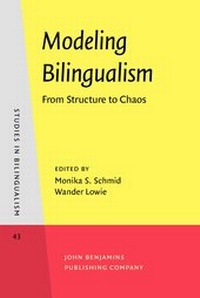
Modeling Bilingualism
From Structure to Chaos. In Honor of Kees de Bot
Published on 14. March 2011
Book
Hardback
308 pages
978-90-272-4182-5 (ISBN)
Description
This volume presents an overview of changes in paradigms, perspectives and contexts of research into bilingual development over the past two decades. During this time, the focus of perspective has changed. In the early 1990s, most investigations still proceeded from models that assumed modular components, hierarchical relationships and linear processes, and investigated what were perceived to be the 'typical' contexts of bilingual development (sequential, usually instructed bilingualism, where the second language would remain the weaker one and the speakers investigated were typically young adults). More recently it has been proposed that such models may not be complex enough to accommodate bilingual development in all its facets and settings (bimodal bilingualism, attrition, aging). This change has recently culminated in applications of chaos theory to Applied Linguistics, and in the widening range of situations of language acquisition, learning and deterioration which have been investigated.
More details
Series
Language
English
Place of publication
Amsterdam
Netherlands
Target group
Professional and scholarly
Dimensions
Height: 245 mm
Width: 164 mm
Weight
735 gr
ISBN-13
978-90-272-4182-5 (9789027241825)
Copyright in bibliographic data and cover images is held by Nielsen Book Services Limited or by the publishers or by their respective licensors: all rights reserved.
Schweitzer Classification
Other editions
Additional editions
Monika S. Schmid | Wander Lowie
Modeling Bilingualism
From Structure to Chaos. In Honor of Kees de Bot
E-Book
03/2011
1st Edition
John Benjamins Publishing Company
€112.99
Available for download
Persons
Content
1. Acknowledgement; 2. Introduction: From structure to chaos: Twenty years of modeling bilingualism (by Larsen-Freeman, Diane); 3. Part I. Multilingualism; 4. Psycholinguistic perspectives on language processing in bilinguals (by Kroll, Judith F.); 5. Triggered code-switching: Evidence from picture naming experiments (by Broersma, Mirjam); 6. Working memory capacity, inhibitory control, and proficiency in a second language (by Gass, Susan M.); 7. Explanations of associations between L1 and L2 literacy skills (by Hulstijn, Jan H.); 8. Part II. Language attrition; 9. The acquisition, attrition, and relearning of mission vocabulary (by Hansen, Lynne); 10. Second language attrition: Theory, research and challenges (by Murtagh, Lelia); 11. Contact x time: External factors and variability in L1 attrition (by Schmid, Monika S.); 12. The shifting structure of emotion semantics across immigrant generations: Effects of the second culture on the first language (by Schrauf, Robert W.); 13. Part III. Language and aging; 14. Bilingualism, code-switching and aging: A myth of attrition and a tale of collaboration (by Clyne, Michael); 15. Language reversion versus general cognitive decline: Towards a new taxonomy of language change in elderly bilingual immigrants (by Keijzer, Merel C.J.); 16. Part IV. DST; 17. A dynamic model of expert-novice co-adaptation during language learning and acquisition (by Geert, Paul van); 18. The dynamics of multilingualism: Levelt's speaking model revisited (by Lowie, Wander); 19. Epilogue: Twenty years of modeling bilingualism: From chaos to structure - and back again (by Weltens, Bert); 20. Address for correspondence; 21. Index