

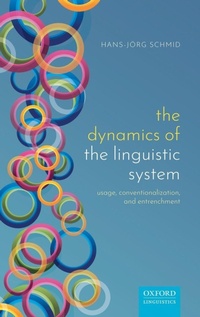
The Dynamics of the Linguistic System
Usage, Conventionalization, and Entrenchment
Published on 9. January 2020
Book
Hardback
432 pages
978-0-19-881477-1 (ISBN)
Description
This volume outlines a model of language that can be characterized as functionalist, usage-based, dynamic, and complex-adaptive. The core idea is that linguistic structure is not stable and uniform, but continually refreshed by the interaction between three components: usage, the communicative activities of speakers; conventionalization, the social processes triggered by these activities and feeding back into them; and entrenchment, the individual cognitive processes that are also linked to these activities in a feedback loop. Hans-Joerg Schmid explains how this multiple feedback system works by extending his Entrenchment-and-Conventionalization Model, showing how the linguistic system is created, sustained, and continually adapted by the ongoing interaction between usage, conventionalization, and entrenchment. Fulfilling the promise of usage-based accounts, the model explains how exactly usage is transformed into collective and individual grammar and how these two grammars in turn feed back into usage.
The book is exceptionally broad in scope, with insights from a wide range of linguistic subdisciplines. It provides a coherent account of the role of multiple factors that influence language structure, variation, and change, including frequency, economy, identity, multilingualism, and language contact.
The book is exceptionally broad in scope, with insights from a wide range of linguistic subdisciplines. It provides a coherent account of the role of multiple factors that influence language structure, variation, and change, including frequency, economy, identity, multilingualism, and language contact.
Reviews / Votes
...the book provides a comprehensive definition of what the language system is and where it locates * Kun Yang and Fei Wang, Southwest Universuty, Cognitive Linguistic Studies - John Benjamins Publishing Company * this book is groundbreaking because it is a usage-based account of the linguistic system... Scholars can apply Schmid's model as a theoretical framework for a whole range of empirical studies. * Shuang Zhang, Huping Zhang, and Philippe Humble, Review of Cognitive Linguistics * This is a ground-breaking magnum opus and a cornerstone of future linguistic thinking and theorizing. * Edgar W. Schneider, English Language and Linguistics * The Dynamics of the Linguistic System: Usage, Conventionalization, and Entrenchment...pioneers the systematic examination of how usage, conventionalization and entrenchment interact to create the linguistic system....Put at its briefest, Schmid proposes the EC-Model by analogizing the way language works as a Tinguely machine, contributing to our understanding of the nature and location of the linguistic system. The theoretical and methodological implications of the model are worth exploring by scholars in many fields, such as functional linguistics, cognitive linguistics, pragmatics, socio-linguistics, psycho-linguistics, etc. * Xiaoming Dong, Harbin Engineering University, China, Journal of Pragmatics *More details
Language
English
Place of publication
Oxford
United Kingdom
Target group
Professional and scholarly
Dimensions
Height: 240 mm
Width: 161 mm
Thickness: 27 mm
Weight
796 gr
ISBN-13
978-0-19-881477-1 (9780198814771)
Copyright in bibliographic data and cover images is held by Nielsen Book Services Limited or by the publishers or by their respective licensors: all rights reserved.
Schweitzer Classification
Other editions
Additional editions
E-Book
01/2020
1st Edition
OUP eBook
€77.49
Available for download
Person
Hans-Joerg Schmid is Full Professor of English Linguistics at Ludwig Maximilians University, Munich. He has taught at Westfield College, London, and at the universities of Dresden, Bochum, and Bayreuth. His research has been devoted to a wide range of fields in linguistics including lexical semantics, grammar, cognitive linguistics, corpus linguistics, word-formation, pragmatics, sociolinguistics, and linguistic theory. His recent publications include English Morphology and Word-Formation (3rd edition; Erich Schmidt, 2016) and, as editor, Entrenchment and the Psychology of Language Learning: How We Reorganize and Adapt Linguistic Knowledge (APA/De Gruyter 2017), Cognitive Pragmatics: Handbooks of Pragmatics Volume 4 (De Gruyter 2012), and Constructions - Collocations - Patterns (with Thomas Herbst and Susen Faulhaber; De Gruyter 2014).
Content
Preface and acknowledgements
List of abbreviations
1: Introduction
Part I: Usage and its potential to feed into conventionalization and entrenchment
2: Usage events and utterance types
3: Co-semiosis and other interpersonal activities
4: Association and cognitive processing
5: Forces affecting usage
6: Summary of Part I
Part II: Conventionalization
7: Understanding the process of conventionalization
8: Usualization
9: Diffusion
10: Summary of Part II
Part III: Entrenchment
11: Understanding the process of entrenchment
12: The routinization of syntagmatic associations
13: The routinization of symbolic associations
14: The routinization of pragmatic associations
15: Summary of part III: How the four types of associations cooperate and compete for routinization
Part IV: Synopsis: The EC-Model as a dynamic complex-adaptive system
16: Summary of the EC-Model
17: Persistence
18: Variation
19: Change
20: Conclusion
References
Index
List of abbreviations
1: Introduction
Part I: Usage and its potential to feed into conventionalization and entrenchment
2: Usage events and utterance types
3: Co-semiosis and other interpersonal activities
4: Association and cognitive processing
5: Forces affecting usage
6: Summary of Part I
Part II: Conventionalization
7: Understanding the process of conventionalization
8: Usualization
9: Diffusion
10: Summary of Part II
Part III: Entrenchment
11: Understanding the process of entrenchment
12: The routinization of syntagmatic associations
13: The routinization of symbolic associations
14: The routinization of pragmatic associations
15: Summary of part III: How the four types of associations cooperate and compete for routinization
Part IV: Synopsis: The EC-Model as a dynamic complex-adaptive system
16: Summary of the EC-Model
17: Persistence
18: Variation
19: Change
20: Conclusion
References
Index