

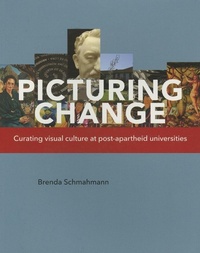
Picturing Change
Curating Visual Culture at Post-apartheid Universities
Published on 1. April 2013
Book
Paperback/Softback
292 pages
978-1-86814-580-5 (ISBN)
Description
An in-depth look at the evolving ethos of curating and collecting art at South African universities.
In Picturing Change, Brenda Schmahmann explores the implications of deploying the visual domain in the service of transformative agendas and unpacks the complexities, contradictions and slippages involved in this process. She shows that although most new commissions have been innovative, some universities have acquired works with potentially traditionalist - even backward-looking - implications. While the motives behind removing inherited imagery may be underpinned by a desire to unsettle white privilege, in some cases such actions can also serve to maintain the status quo. This book is unique in exploring the transformative ethos evident in the curation of visual culture at South African universities. It will be invaluable to readers interested in public art, the politics of curating and collecting, as well as to those involved in transforming tertiary and other public institutions into spaces that welcome diversity.
Since South Africa's transition to democracy, many universities have acquired new works of art that convey messages about the advantages of cultural diversity, and engage critically with histories of racial intolerance and conflict. Given concerns about the influence of British imperialism or Afrikaner nationalism on aspects of their inherited visual culture, most tertiary institutions are also seeking new ways to manage their existing art collections, and to introduce memorials, insignia or regalia, which reflect the universities' newfound values and aspirations.
In Picturing Change, Brenda Schmahmann explores the implications of deploying the visual domain in the service of transformative agendas and unpacks the complexities, contradictions and slippages involved in this process. She shows that although most new commissions have been innovative, some universities have acquired works with potentially traditionalist - even backward-looking - implications. While the motives behind removing inherited imagery may be underpinned by a desire to unsettle white privilege, in some cases such actions can also serve to maintain the status quo. This book is unique in exploring the transformative ethos evident in the curation of visual culture at South African universities. It will be invaluable to readers interested in public art, the politics of curating and collecting, as well as to those involved in transforming tertiary and other public institutions into spaces that welcome diversity.
Since South Africa's transition to democracy, many universities have acquired new works of art that convey messages about the advantages of cultural diversity, and engage critically with histories of racial intolerance and conflict. Given concerns about the influence of British imperialism or Afrikaner nationalism on aspects of their inherited visual culture, most tertiary institutions are also seeking new ways to manage their existing art collections, and to introduce memorials, insignia or regalia, which reflect the universities' newfound values and aspirations.
More details
Language
English
Place of publication
Johannesburg
South Africa
Target group
Professional and scholarly
Product notice
Paperback (trade)
Illustrations
120 Illustrations, color
Dimensions
Height: 249 mm
Width: 197 mm
Thickness: 22 mm
Weight
868 gr
ISBN-13
978-1-86814-580-5 (9781868145805)
Copyright in bibliographic data and cover images is held by Nielsen Book Services Limited or by the publishers or by their respective licensors: all rights reserved.
Schweitzer Classification
Other editions
Additional editions
E-Book
04/2013
Abingdon Press
€29.49
Available for download
Person
Brenda Schmahmann is Professor in the Faculty of Art, Design and Architecture at the University of Johannesburg.
Content
Negotiating sculptures and memorials from the early twentieth century; Rethinking university insignia; New art acquisitions; Portraits of university officers; Controversies.