

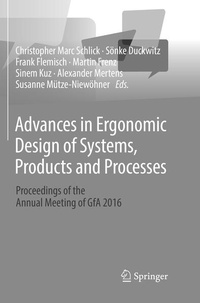
Advances in Ergonomic Design of Systems, Products and Processes
Proceedings of the Annual Meeting of GfA 2016
Published on 5. July 2018
Book
Paperback/Softback
IX, 366 pages
978-3-662-57130-9 (ISBN)
Description
These proceedings summarize the best papers in each research field represented at the 2016 Annual Meeting of the Human Factors and Ergonomics Society (GfA) in the German-speaking area, held at Institute of Industrial Engineering and Ergonomics of RWTH Aachen University from March 2-4. The meeting featured more than 200 presentations and 36 posters reflecting the diversity of subject matter in the field of human and industrial engineering. This volume addresses human factors and safety specialists, industrial engineers, work and organizational psychologists, occupational medicines as well as production planners and design engineers.
More details
Edition
Softcover reprint of the original 1st ed. 2017
Language
English
Place of publication
Berlin
Germany
Publishing group
Springer Berlin
Target group
Professional and scholarly
Illustrations
33 s/w Abbildungen, 87 farbige Abbildungen
IX, 366 p. 120 illus., 87 illus. in color.
Dimensions
Height: 235 mm
Width: 155 mm
Thickness: 21 mm
Weight
569 gr
ISBN-13
978-3-662-57130-9 (9783662571309)
DOI
10.1007/978-3-662-53305-5
Schweitzer Classification
Other editions
Additional editions
Christopher Marc Schlick | Sönke Duckwitz | Frank Flemisch
Advances in Ergonomic Design of Systems, Products and Processes
Proceedings of the Annual Meeting of GfA 2016
Book
12/2016
Springer
€213.99
Shipment within 7-9 days
Content
Best-practice approach for a solution-oriented technology assessment.- Human-oriented productivity management as a key criterion for success in the digitalised working world.- Resource Constrained Projekt Scheduling Problem.- Fields of Action for Work Design in Industrie 4.0.- Skilled Workers - are they Losers of "Industry 4.0"?.- Work Requirements and Qualifications in Maintenance 4.0.- Development of a Business Game for Teaching the Kanban Method.- Training interventions to increase innovations in age-diverse teams.- Change into an Ergonomic 3 Shift Model with a Reduction of the Night Shifts for all Workers.- Vocational Competency Management through the use of Serious Games.- Retirement research requires a broad view and interdisciplinarity.- Age-differentiated Analysis of the Influence of Task Descriptions on Learning Sensorimotor Tasks.- The potential of virtual interactive learning environments for individual andorganizational learning.- Designing Rooms for Virtual, Informal Communication.- Analysis of the stress and strain of repetitive assembly tasks.- Analysis and evaluation of physical workload during long-cyclic tasks as a prerequisite for ergonomic work design.- Walking "normally" vs. "sideways" in simulated, simple assembly operations.- 1 Analysis of a multimodal human-robot-interface in terms of mental workload.- How to evaluate the usability of smart devices as conceivable work assistance.- An age-differentiated perspective on visualizations of personal health data.- How the Duration of Automated Driving Influences.- Take-Over Performance and Gaze Behavior.- Uncanny and unsafe valley of assistance and automation.- Man-Robot Collaboration in the context of Industry 4.0.- Joint angle depending representation of maximum forces in digital human models.