

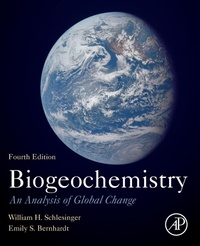
Biogeochemistry
An Analysis of Global Change
4th Edition
Published on 22. October 2020
Book
Paperback/Softback
762 pages
978-0-12-814608-8 (ISBN)
Description
Biogeochemistry: An Analysis of Global Change, Fourth Edition, considers how the basic chemical conditions of the Earth, from atmosphere to soil to seawater, have been, and are being, affected by the existence of life. Human activities in particular, from the rapid consumption of resources to the destruction of the rainforests and the expansion of smog-covered cities, are leading to rapid changes in the basic chemistry of the Earth. The new edition features expanded coverage of topics, including the cryosphere, the global hydrogen cycle, biomineralization and the movement of elements across landscapes and continents by organisms and through global trade.
The book will help students and researchers extrapolate small-scale examples to a global level. With cross-referencing of chapters, figures and tables, and an interdisciplinary coverage of the topic, this updated edition provides an excellent framework for examining global change and environmental chemistry.
The book will help students and researchers extrapolate small-scale examples to a global level. With cross-referencing of chapters, figures and tables, and an interdisciplinary coverage of the topic, this updated edition provides an excellent framework for examining global change and environmental chemistry.
More details
Edition
4th edition
Language
English
Place of publication
San Diego
United States
Publishing group
Elsevier Science Publishing Co Inc
Target group
Adult education
College/higher education
Upper-division undergraduate and graduate students in geochemistry, ecology, earth, and soil sciences, especially those with interest in global change or environmental chemistry
Dimensions
Height: 233 mm
Width: 184 mm
Thickness: 51 mm
Weight
1564 gr
ISBN-13
978-0-12-814608-8 (9780128146088)
Copyright in bibliographic data and cover images is held by Nielsen Book Services Limited or by the publishers or by their respective licensors: all rights reserved.
Schweitzer Classification
Other editions
Additional editions
E-Book
08/2020
4th Edition
Academic Press
€113.00
Available for download
Previous edition
Book
01/2013
3rd Edition
Academic Press
€91.75
Article exhausted; check for reprint
Persons
Dr. Schlesinger is one of the nation's leading ecologists and earth scientists and a passionate advocate for translating science for lay audiences. A member of the National Academy of Sciences, he has served as dean of the Nicholas School of the Environment at Duke and president of the Cary Institute of Ecosystem Studies. He lives in Down East Maine and Durham, N.C. and continues to analyze the impacts of humans on the chemistry of our natural environment. Dr. Bernhardt is James B. Duke Distinguished Professor in the Department of Biology at Duke University. She is a Fellow of the Ecological Society of America and the Society for Freshwater Sciences and currently serves as the chair of Duke's Department of Biology. She lives in Durham, NC where she enjoys introducing Duke students to the wonders of ecology and biogeochemistry each year.
Content
I. Processes and reactions
1. Introduction
2. Origins
3. The atmosphere
4. The lithosphere
5. The carbon cycle of terrestrial ecosystems
6. Biogeochemical cycling on land
7. Wetland ecosystems
8. Inland waters
9. The oceans
II. Global cycles
10. The global water cycle
11. The global carbon and oxygen cycles
12. The global cycles of nitrogen, phosphorus and potassium
13. The global cycles of sulfur and mercury
14. Coda
1. Introduction
2. Origins
3. The atmosphere
4. The lithosphere
5. The carbon cycle of terrestrial ecosystems
6. Biogeochemical cycling on land
7. Wetland ecosystems
8. Inland waters
9. The oceans
II. Global cycles
10. The global water cycle
11. The global carbon and oxygen cycles
12. The global cycles of nitrogen, phosphorus and potassium
13. The global cycles of sulfur and mercury
14. Coda