

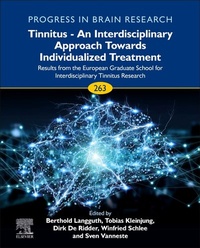
Tinnitus - An Interdisciplinary Approach Towards Individualized Treatment: Volume 263
Results from the European Graduate School for Interdisciplinary Tinnitus Research
Published on 27. May 2021
Book
Hardback
232 pages
978-0-12-822377-2 (ISBN)
Description
Progress in Brain Research series highlights new advances in the field, with this new volume presenting interesting chapters. Each chapter is written by an international board of authors.
More details
Series
Language
English
Place of publication
United States
Target group
Professional and scholarly
Undergraduates, graduates, academics, and researchers in the topic of tinnitus
Dimensions
Height: 235 mm
Width: 191 mm
Weight
660 gr
ISBN-13
978-0-12-822377-2 (9780128223772)
Copyright in bibliographic data and cover images is held by Nielsen Book Services Limited or by the publishers or by their respective licensors: all rights reserved.
Schweitzer Classification
Other editions
Additional editions

Tinnitus - An Interdisciplinary Approach Towards Individualized Treatment
Results from the European Graduate School for Interdisciplinary Tinnitus Research
E-Book
05/2021
Elsevier
€206.00
Available for download
Persons
Winfried Schlee is at University of Regensburg, Germany. Berthold Langguth is at University of Regensburg, Germany. Tobias Kleinjung is at University Hospital Zurich, Switzerland. Sven Vanneste is at Trinity College Dublin, Ireland. Dirk de Ridder is at University of Otago, New Zealand.
Content
1. Modifiable lifestyle-related risk factors for tinnitus in the general population: an overview of smoking, alcohol, body mass index and caffeine intake
Roshni Biswas
2. Using a Visual Analog Scale (VAS) to measure tinnitus-related distress and loudness: Investigating correlations using the Mini-TQ questionnaire results of participants from the TrackYourTinnitus platform
Albi Dode, Muntazir Mehdi, Ruediger Pryss, Winfried Schlee and Thomas Probst
3. The spatial percept of tinnitus is associated with hearing asymmetry: subgroup comparisons
Eleni Genitsaridi, Niklas Edvall, Derek James Hoare, Christopher R. Cederroth and Deborah Ann Hall
4. Advancing tinnitus research and researcher training: a case study review and future perspectives
Derek James Hoare and Winfried Schlee
5. Investigation of the effect of HD-tDCS on tinnitus in a large patient cohort.
Laure Jacquemin
6. Data driven identification of tinnitus subtypes: a latent class analysis of a large sample
Berthold Langguth
7. Effects of Ecological Momentary Assessment (EMA) induced monitoring on tinnitus experience: a multiple-baseline single-case experiment
Matheus P C G Lourenco
8. Smartphone based Ecological Momentary Assessment of Tinnitus
Muntazir Mehdi
9. Gender differentiates effects of acoustic stimulation in Tinnitus patients
Marta Partyka
10. Reflections on a 5-Year Mobile Crowdsensing Ride for Tinnitus Research from a Technical Viewpoint
Rudiger Pryss
11. Investigating the variability of Minimum Masking Levels for tinnitus subtyping
Jose L. Santacruz
12. Cluster analysis of neural oscillatory correlates of hyperacusis in chronic tinnitus
Martin Schecklmann
13. Unification of treatments and Interventions for Tinnitus patients - the UNITI project
Winfried Schlee
14. Electrophysiological evaluation of high and low frequency transcranial random noise stimulation over the auditory cortex
Stefan Schoisswohl
15. Time-Lagged Cross-Correlation of Tinnitus Symptoms Using Ecological Momentary Assessment
Jorge Simoes
16. Effectiveness of bimodal auditory and electrical stimulation' treatment in patients with tinnitus: A pilot study
Shikha Spencer
17. Multidisciplinary tinnitus research: challenges and future directions
Eleni Genitsaridi
18. Application of Latent Growth Curve Modeling to Predict Individual Trajectories during Neurofeedback Treatment for Tinnitus
Constanze Riha
Roshni Biswas
2. Using a Visual Analog Scale (VAS) to measure tinnitus-related distress and loudness: Investigating correlations using the Mini-TQ questionnaire results of participants from the TrackYourTinnitus platform
Albi Dode, Muntazir Mehdi, Ruediger Pryss, Winfried Schlee and Thomas Probst
3. The spatial percept of tinnitus is associated with hearing asymmetry: subgroup comparisons
Eleni Genitsaridi, Niklas Edvall, Derek James Hoare, Christopher R. Cederroth and Deborah Ann Hall
4. Advancing tinnitus research and researcher training: a case study review and future perspectives
Derek James Hoare and Winfried Schlee
5. Investigation of the effect of HD-tDCS on tinnitus in a large patient cohort.
Laure Jacquemin
6. Data driven identification of tinnitus subtypes: a latent class analysis of a large sample
Berthold Langguth
7. Effects of Ecological Momentary Assessment (EMA) induced monitoring on tinnitus experience: a multiple-baseline single-case experiment
Matheus P C G Lourenco
8. Smartphone based Ecological Momentary Assessment of Tinnitus
Muntazir Mehdi
9. Gender differentiates effects of acoustic stimulation in Tinnitus patients
Marta Partyka
10. Reflections on a 5-Year Mobile Crowdsensing Ride for Tinnitus Research from a Technical Viewpoint
Rudiger Pryss
11. Investigating the variability of Minimum Masking Levels for tinnitus subtyping
Jose L. Santacruz
12. Cluster analysis of neural oscillatory correlates of hyperacusis in chronic tinnitus
Martin Schecklmann
13. Unification of treatments and Interventions for Tinnitus patients - the UNITI project
Winfried Schlee
14. Electrophysiological evaluation of high and low frequency transcranial random noise stimulation over the auditory cortex
Stefan Schoisswohl
15. Time-Lagged Cross-Correlation of Tinnitus Symptoms Using Ecological Momentary Assessment
Jorge Simoes
16. Effectiveness of bimodal auditory and electrical stimulation' treatment in patients with tinnitus: A pilot study
Shikha Spencer
17. Multidisciplinary tinnitus research: challenges and future directions
Eleni Genitsaridi
18. Application of Latent Growth Curve Modeling to Predict Individual Trajectories during Neurofeedback Treatment for Tinnitus
Constanze Riha