

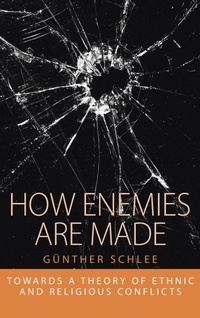
How Enemies Are Made
Towards a Theory of Ethnic and Religious Conflict
1st Edition
Published on 1. September 2008
Book
Hardback
206 pages
978-1-84545-494-4 (ISBN)
Description
In popular perception cultural differences or ethnic affiliation are factors that cause conflict or political fragmentation although this is not borne out by historical evidence. This book puts forward an alternative conflict theory. The author develops a decision theory which explains the conditions under which differing types of identification are preferred. Group identification is linked to competition for resources like water, territory, oil, political charges, or other advantages. Rivalry for resources can cause conflicts but it does not explain who takes whose side in a conflict situation. This book explores possibilities of reducing violent conflicts and ends with a case study, based on personal experience of the author, of conflict resolution.
Reviews / Votes
"This is certainly a significant text, and would be of interest to most scholars studying conflict theory...[it] represents an interesting discussion of conflict resolution and would be most beneficial to those seeking an alternate to traditional conflict analysis. While the author does not offer his own theory, he does successfully lay the groundwork for future conflict analysts to develop their own perspectives." ? The Canadian Review of Sociology/Revue canadienne de sociologieMore details
Series
Language
English
Place of publication
Oxford
United Kingdom
Target group
College/higher education
Product notice
Library binding
Illustrations
5 Tables, unspecified; 5 Diagrams
Dimensions
Height: 235 mm
Width: 157 mm
Thickness: 16 mm
Weight
457 gr
ISBN-13
978-1-84545-494-4 (9781845454944)
DOI
10.3167/9781845454944
Copyright in bibliographic data and cover images is held by Nielsen Book Services Limited or by the publishers or by their respective licensors: all rights reserved.
Schweitzer Classification
Other editions
Additional editions
E-Book
09/2008
1st Edition
Berghahn Books
€24.49
Available for download
E-Book
09/2008
1st Edition
Berghahn Books
€26.99
Available for download
Person
Guenther Schlee was a Professor at Bielefeld until 1999. He currently is the director of the section Integration and Conflict at the Max Planck Institute for Social Anthropology, Halle, focusing on Africa, Central Asia, and Europe. His publications include Identities on the Move: Clanship and Pastoralism in Northern Kenya (International African Institute, 1989), How Enemies are Made (Berghahn, 2008), Rendille Proverbs in their Social and legal Context (with Karaba Sahado) and Boran Proverbs in their Cultural Context (with Abdullahi Shongolo) (both Cologne: Ruediger Koeppe).
Content
PART I: INTRODUCTION
Chapter 1. Why we Need a New Conflict Theory
Chapter 2. The Question
Chapter 3. How this Volume is Organised
PART II: THEORETICAL FRAME
Chapter 4. A Decision Theory of Identification
Chapter 5. The Necessity for Strategies of Inclusion and Exclusion
Chapter 6. The Conceptual Instruments of Exclusion and Inclusion: Social Categories and their Overlapping Relations
Chapter 7. On the Sociologisation of Economics and the Economisation of Sociology
Chapter 8. Markets of Violence and the Freedom of Choice
Chapter 9. Ethnicity Emblems, Diacritical Features, Identity Markers - Some East African Examples
Chapter 10. Purity and Power in Islamic and Non-Islamic Societies and the Spectre of Fundamentalism
Chapter 11. Language and Ethnicity
PART III: PRACTICAL FRAME
Chapter 12. Conflict Resolution: the Experience with the Somali Peace Process
Chapter 13. On Methods: How to be a Conflict Analyst
Chapter 14. An Update from 2007: Reconsidering the Peace Process
List of Acronyms
References
Index
Chapter 1. Why we Need a New Conflict Theory
Chapter 2. The Question
Chapter 3. How this Volume is Organised
PART II: THEORETICAL FRAME
Chapter 4. A Decision Theory of Identification
Chapter 5. The Necessity for Strategies of Inclusion and Exclusion
Chapter 6. The Conceptual Instruments of Exclusion and Inclusion: Social Categories and their Overlapping Relations
Chapter 7. On the Sociologisation of Economics and the Economisation of Sociology
Chapter 8. Markets of Violence and the Freedom of Choice
Chapter 9. Ethnicity Emblems, Diacritical Features, Identity Markers - Some East African Examples
Chapter 10. Purity and Power in Islamic and Non-Islamic Societies and the Spectre of Fundamentalism
Chapter 11. Language and Ethnicity
PART III: PRACTICAL FRAME
Chapter 12. Conflict Resolution: the Experience with the Somali Peace Process
Chapter 13. On Methods: How to be a Conflict Analyst
Chapter 14. An Update from 2007: Reconsidering the Peace Process
List of Acronyms
References
Index