

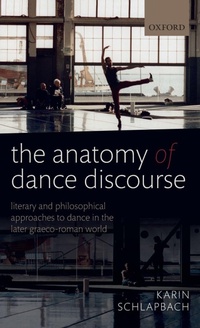
The Anatomy of Dance Discourse
Literary and Philosophical Approaches to Dance in the Later Graeco-Roman World
Published on 14. December 2017
Book
Hardback
352 pages
978-0-19-880772-8 (ISBN)
Description
Within the newly thriving field of ancient Greek and Roman performance and dance studies, The Anatomy of Dance Discourse offers a fresh and original perspective on ancient perceptions of dance. Focusing on the second century CE, it provides an overview of the dance discourse of this period and explores the conceptualization of dance across an array of different texts, from Plutarch and Lucian of Samosata, to the apocryphal Acts of John, Longus, and Apuleius.
The volume is divided into two parts: while the second part discusses ekphraseis of dance performance in prose and poetry of the Roman imperial period, the first delves more deeply into an examination of how both philosophical and literary treatments of dance interacted with other areas of cultural expression, whether language and poetry, rhetoric and art, or philosophy and religion. Its distinctive contribution lies in this juxtaposition of ancient theorizations of dance and philosophical analyses of the medium with literary depictions of dance scenes and performances, and it attends not only to the highly encoded genre of pantomime, which dominated the stage in the Roman Empire, but also to acrobatic, non-representational dances. This twofold nature of dance sparked highly sophisticated reflections on the relationship between dance and meaning in the ancient world, and the volume defends the novel claim that in the imperial period it became more and more palpable that dance, unlike painting or sculpture, could be representational or not: a performance of nothing but itself. It argues that dance was understood as a practice in which human beings, whether as dancers or spectators, are confronted with the irreducible reality of their own physical existence, which is constantly changing, and that its way to cognition and action is physical experience.
The volume is divided into two parts: while the second part discusses ekphraseis of dance performance in prose and poetry of the Roman imperial period, the first delves more deeply into an examination of how both philosophical and literary treatments of dance interacted with other areas of cultural expression, whether language and poetry, rhetoric and art, or philosophy and religion. Its distinctive contribution lies in this juxtaposition of ancient theorizations of dance and philosophical analyses of the medium with literary depictions of dance scenes and performances, and it attends not only to the highly encoded genre of pantomime, which dominated the stage in the Roman Empire, but also to acrobatic, non-representational dances. This twofold nature of dance sparked highly sophisticated reflections on the relationship between dance and meaning in the ancient world, and the volume defends the novel claim that in the imperial period it became more and more palpable that dance, unlike painting or sculpture, could be representational or not: a performance of nothing but itself. It argues that dance was understood as a practice in which human beings, whether as dancers or spectators, are confronted with the irreducible reality of their own physical existence, which is constantly changing, and that its way to cognition and action is physical experience.
Reviews / Votes
The reader of this book is in no danger of committing the error of Apuleius' 'scholarly ass': it is truly an exemplary piece of scholarship... It is to be recommended to all scholars interested in ancient dance and ancient literature on dance, performance studies, ekphrasis, the relation between the arts in antiquity as well as their relevance in rhetoric, philosophy and religious discourse. * Julia Pfefferkorn, Tuebingen, Gnomon: Kritische Zeitschrift fuer die Gesamte Klassische Altertumswissenschaft *More details
Language
English
Place of publication
Oxford
United Kingdom
Target group
College/higher education
Illustrations
4 black-and-white illustrations
Dimensions
Height: 222 mm
Width: 145 mm
Thickness: 22 mm
Weight
574 gr
ISBN-13
978-0-19-880772-8 (9780198807728)
Copyright in bibliographic data and cover images is held by Nielsen Book Services Limited or by the publishers or by their respective licensors: all rights reserved.
Schweitzer Classification
Other editions
Additional editions
Karin Schlapbach
The Anatomy of Dance Discourse
Literary and Philosophical Approaches to Dance in the Later Graeco-Roman World
E-Book
12/2017
1st Edition
OUP eBook
€75.49
Available for download
Karin Schlapbach
The Anatomy of Dance Discourse
Literary and Philosophical Approaches to Dance in the Later Graeco-Roman World
E-Book
12/2017
1st Edition
OUP eBook
€75.49
Available for download
Person
Karin Schlapbach holds a PhD in Classics from the University of Zurich. She joined the Institut du monde antique et byzantin at the University of Fribourg in 2017 after teaching classics for nine years in the Department of Classics and Religious Studies at the University of Ottawa. She has also occupied research positions at various institutions in the USA, the UK, and Germany. Her research focuses on the literature of the imperial period and late antiquity and she has published widely on dance and pantomime, philosophical prose, and the modern reception of late antiquity.
Content
FRONTMATTER; PART I. FRAMEWORKS FOR A DISCOURSE ON DANCE; PART II. EKPHRASEIS OF DANCES; ENDMATTER