


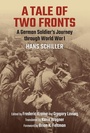
A Tale of Two Fronts
A German Soldier's Journey Through World War I
Published on 16. December 2024
Book
Hardback
224 pages
978-0-7006-3800-0 (ISBN)
Description
In 2013, while helping her mother, Ingrid, comb through family possessions, Karin Wagner came across a large folio handwritten in German in the back of a dresser drawer. When Karin asked her mother what the document was, Ingrid replied, "Oh, that is your grandfather's Great War memoir."Schiller was a seventeen-year-old student in Bromberg, Prussia, when World War I broke out in August 1914. He enlisted in the German army and was assigned to an artillery unit on the Eastern Front. From 1915 to 1917, Schiller saw action in what is now Latvia, Lithuania, and Poland. After the Bolshevik Revolution in October 1917 and Russia's withdrawal from the war, Schiller was transferred to the Western Front. He arrived in time for Germany's last great offensive in the west, where the attempt to break the Allied lines included what is believed to be the single greatest artillery bombardment in human history up to that point. After the German retreat and Armistice, Schiller reentered military service in the Freikorps, German mercenary groups fighting in former German territory in Eastern Europe, where the conflict dragged on even after the Treaty of Versailles. Schiller left military service in May 1920.
Hans Schiller's Kriegserinnerungen (literally, "memories of war") was written in 1928 and based on diaries, since lost, that Schiller kept during the war. A Tale of Two Fronts, an edition of the memoir with historical context and explanatory notes, provides a vivid first-person account of German army life during World War I. It is a valuable resource for anyone interested in the experiences of common soldiers in World War I.
Hans Schiller's Kriegserinnerungen (literally, "memories of war") was written in 1928 and based on diaries, since lost, that Schiller kept during the war. A Tale of Two Fronts, an edition of the memoir with historical context and explanatory notes, provides a vivid first-person account of German army life during World War I. It is a valuable resource for anyone interested in the experiences of common soldiers in World War I.
More details
Edition
Foreword by Brian K. Feltman
Language
English
Place of publication
Kansas
United States
Product notice
With printed dust jacket
Illustrations
41 b&w photographs, 2 maps
Dimensions
Height: 235 mm
Width: 157 mm
Thickness: 18 mm
Weight
535 gr
ISBN-13
978-0-7006-3800-0 (9780700638000)
Copyright in bibliographic data and cover images is held by Nielsen Book Services Limited or by the publishers or by their respective licensors: all rights reserved.
Schweitzer Classification
Other editions
Additional editions
E-Book
11/2024
University Press of Kansas
€14.49
Available for download
Persons
Frederic Krome is professor of history, University of Cincinnati Clermont College, and the author of The Jewish Hospital and Cincinnati Jews in Medicine and Fighting the Future War: An Anthology of Science Fiction War Stories, 1914-1945
Gregory D. Loving is professor of philosophy, University of Cincinnati Clermont College. His articles have appeared in Philosophical Studies in Education, Academe, Interdisciplinary Humanities, and other publications.
Karin Wagner is CEO, founder, and executive director of the Neigh Savers Foundation, a horse rescue organization in California.
Brian K. Feltman is associate professor of history, Georgia Southern University, a specialist in Germany in the World War I era, and the author of The Stigma of Surrender: German Prisoners, British Captors, and Manhood in the Great War and Beyond.
Gregory D. Loving is professor of philosophy, University of Cincinnati Clermont College. His articles have appeared in Philosophical Studies in Education, Academe, Interdisciplinary Humanities, and other publications.
Karin Wagner is CEO, founder, and executive director of the Neigh Savers Foundation, a horse rescue organization in California.
Brian K. Feltman is associate professor of history, Georgia Southern University, a specialist in Germany in the World War I era, and the author of The Stigma of Surrender: German Prisoners, British Captors, and Manhood in the Great War and Beyond.