

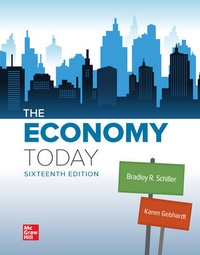
The Economy Today
16th Edition
Published on 26. April 2021
Book
Hardback
978-1-260-93299-7 (ISBN)
Description
The Economy Today is noted for three great strengths: currency, policy focus, and readability. The accessible writing style engages students and brings the excitement of domestic and global economic news into the classroom.
Schiller/Gebhardt emphasizes how policymakers must choose between government intervention and market reliance to resolve the core issues of what, how, and for whom to produce. These strategic trade-offs are highlighted throughout the full range of micro, macro, and international issues, and every chapter ends with a policy issue that emphasizes the market versus government dilemma.
The authors teach economics in a current and relevant context, including the COVID Pandemic of 2020, filling chapters with the real facts and applications of economic life. Schiller/Gebhardt is also the only principles text that presents all macro theory in the single consistent context of the AS/AD framework and uniquely features a full supply-side economics chapter. You will also find the current Economist in Chief, Joe Biden, featured in the opening chapter.
The authors have worked to ensure The Economy Today, 16th edition, is tightly integrated with the adaptive digital tools and dynamic interactive resources available in Connect. Connect is proven to increase student engagement and success. For professors there is also an updated instructor guide to bring new ideas to your course, no matter the format.
Schiller/Gebhardt emphasizes how policymakers must choose between government intervention and market reliance to resolve the core issues of what, how, and for whom to produce. These strategic trade-offs are highlighted throughout the full range of micro, macro, and international issues, and every chapter ends with a policy issue that emphasizes the market versus government dilemma.
The authors teach economics in a current and relevant context, including the COVID Pandemic of 2020, filling chapters with the real facts and applications of economic life. Schiller/Gebhardt is also the only principles text that presents all macro theory in the single consistent context of the AS/AD framework and uniquely features a full supply-side economics chapter. You will also find the current Economist in Chief, Joe Biden, featured in the opening chapter.
The authors have worked to ensure The Economy Today, 16th edition, is tightly integrated with the adaptive digital tools and dynamic interactive resources available in Connect. Connect is proven to increase student engagement and success. For professors there is also an updated instructor guide to bring new ideas to your course, no matter the format.
More details
Edition
16th edition
Language
English
Place of publication
OH
United States
Target group
College/higher education
Weight
1851 gr
ISBN-13
978-1-260-93299-7 (9781260932997)
Copyright in bibliographic data and cover images is held by Nielsen Book Services Limited or by the publishers or by their respective licensors: all rights reserved.
Schweitzer Classification
Persons
Bradley R. Schiller has more than four decades of experience teaching introductory economics at American University, the University of Nevada, the University of California (Berkeley and Santa Cruz), and the University of Maryland. He has given guest lectures at more than 300 colleges ranging from Fresno, California, to Istanbul, Turkey. Dr. Schillers unique contribution to teaching is his ability to relate basic principles to current socioeconomic problems, institutions, and public policy decisions. This perspective is evident throughout The Economy Today. Dr. Schiller derives this policy focus from his extensive experience as a Washington consultant. He has been a consultant to most major federal agencies, many congressional committees, political candidates, and presidents. In addition, he has evaluated scores of government programs and helped design others. His studies of poverty, discrimination, training programs, tax reform, pensions, welfare, Social Security, and lifetime wage patterns have appeared in both professional journals and popular media. Dr. Schiller is also a frequent commentator on economic policy for television and radio, and his commentary has appeared in The Wall Street Journal, The Washington Post, The New York Times, and Los Angeles Times, among other major newspapers. Dr. Schiller received his Ph.D. from Harvard and his B.A. degree, with great distinction, from the University of California (Berkeley). On his days off, Dr. Schiller is on the tennis courts, the ski slopes, or the crystal-blue waters of Lake Tahoe.
Karen Gebhardt is a faculty member in the Department of Economics and is the Director of the Online Economics Program at the University of Colorado Boulder. Dr. Gebhardt has a passion for teaching economics. She regularly instructs courses in all modalities (online, on campus, hybrid, remote) from introductory courses in macro- and microeconomics, to upper-division courses in microeconomics, international trade, and managerial economics and graduate courses in environmental economics and public finance. She is an early adopter of teaching with technology and advocates strongly for it because she sees the difference it makes in student engagement and learning. Dr. Gebhardt was the recipient of the Water Pik Excellence in Education Award in 2006 and was awarded the Best Teacher Award in 2015 while she was at Colorado State University. Dr. Gebhardts research interests, publications, and presentations involve the economics and online education and the economics of humanwildlife interaction. Before returning to academia, she worked as an economist at the U.S. Department of Agriculture/Animal and Plant Health Inspection Service/Wildlife Services/National Wildlife Research Center, conducting research related to the interactions of humans and wildlife. Her current research focuses on using data to improve student learning outcomes in economics education with an emphasis on improving grades and completion rates in online courses. In her free time, Dr. Gebhardt enjoys learning about new teaching methods that integrate technology and going rock climbing and camping in the Colorado Rockies and beyond.
Karen Gebhardt is a faculty member in the Department of Economics and is the Director of the Online Economics Program at the University of Colorado Boulder. Dr. Gebhardt has a passion for teaching economics. She regularly instructs courses in all modalities (online, on campus, hybrid, remote) from introductory courses in macro- and microeconomics, to upper-division courses in microeconomics, international trade, and managerial economics and graduate courses in environmental economics and public finance. She is an early adopter of teaching with technology and advocates strongly for it because she sees the difference it makes in student engagement and learning. Dr. Gebhardt was the recipient of the Water Pik Excellence in Education Award in 2006 and was awarded the Best Teacher Award in 2015 while she was at Colorado State University. Dr. Gebhardts research interests, publications, and presentations involve the economics and online education and the economics of humanwildlife interaction. Before returning to academia, she worked as an economist at the U.S. Department of Agriculture/Animal and Plant Health Inspection Service/Wildlife Services/National Wildlife Research Center, conducting research related to the interactions of humans and wildlife. Her current research focuses on using data to improve student learning outcomes in economics education with an emphasis on improving grades and completion rates in online courses. In her free time, Dr. Gebhardt enjoys learning about new teaching methods that integrate technology and going rock climbing and camping in the Colorado Rockies and beyond.
Content
Chapter 1: Economics: The Core Issues
Chapter 2: The U.S. Economy: A Global View
Chapter 3: Supply and Demand
Chapter 4: The Role of Government
Chapter 5: National Income Accounting
Chapter 6: Unemployment
Chapter 7: Inflation
Chapter 8: The Business Cycle
Chapter 9: Aggregate Demand
Chapter 10: Self-Adjustment or Instability?
Chapter 11: Fiscal Policy
Chapter 12: Debt
Chapter 13: Money and Banks
Chapter 14: The Federal Reserve System
Chapter 15: Monetary Policy
Chapter 16: Supply-Side Policy
Chapter 17: Growth and Productivity
Chapter 18: Theory versus Reality
Chapter 19: Consumer Choice
Chapter 20: Elasticity
Chapter 21: The Costs of Production
Chapter 22: The Competitive Firm
Chapter 23: Competitive Markets
Chapter 24: Monopoly
Chapter 25: Oligopoly
Chapter 26: Monopolistic Competition
Chapter 27: Natural Monopolies
Chapter 28: Environmental Protection
Chapter 29: The Farm Problem
Chapter 30: The Labor Market
Chapter 31: Labor Unions
Chapter 32: Financial Markets
Chapter 33: Taxes: Equity versus Efficiency
Chapter 34: Transfer Payments: Welfare and Social Security
Chapter 35: International Trade
Chapter 36: International Finance
Chapter 37: Global Poverty
Chapter 2: The U.S. Economy: A Global View
Chapter 3: Supply and Demand
Chapter 4: The Role of Government
Chapter 5: National Income Accounting
Chapter 6: Unemployment
Chapter 7: Inflation
Chapter 8: The Business Cycle
Chapter 9: Aggregate Demand
Chapter 10: Self-Adjustment or Instability?
Chapter 11: Fiscal Policy
Chapter 12: Debt
Chapter 13: Money and Banks
Chapter 14: The Federal Reserve System
Chapter 15: Monetary Policy
Chapter 16: Supply-Side Policy
Chapter 17: Growth and Productivity
Chapter 18: Theory versus Reality
Chapter 19: Consumer Choice
Chapter 20: Elasticity
Chapter 21: The Costs of Production
Chapter 22: The Competitive Firm
Chapter 23: Competitive Markets
Chapter 24: Monopoly
Chapter 25: Oligopoly
Chapter 26: Monopolistic Competition
Chapter 27: Natural Monopolies
Chapter 28: Environmental Protection
Chapter 29: The Farm Problem
Chapter 30: The Labor Market
Chapter 31: Labor Unions
Chapter 32: Financial Markets
Chapter 33: Taxes: Equity versus Efficiency
Chapter 34: Transfer Payments: Welfare and Social Security
Chapter 35: International Trade
Chapter 36: International Finance
Chapter 37: Global Poverty