

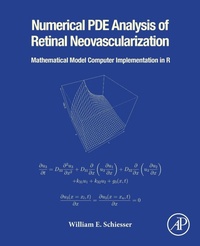
Numerical PDE Analysis of Retinal Neovascularization
Mathematical Model Computer Implementation in R
Published on 14. June 2019
Book
Paperback/Softback
144 pages
978-0-12-818452-3 (ISBN)
Description
Numerical PDE Analysis of Retinal Neovascularization Mathematical Model Computer Implementation in R provides a methodology for the analysis of neovascularization (formation of blood capillaries) in the retina. It describes the starting point-a system of three partial differential equations (PDEs)-that define the evolution of (1) capillary tip density, (2) blood capillary density and (3) concentration of vascular endothelial growth factor (VEGF) in the retina as a function of space (distance along the retina), x, and time, t, the three PDE dependent variables for (1), (2) and (3), and designated as u1(x, t), u2(x, t), u3(x, t), amongst other topics.
More details
Language
English
Place of publication
San Diego
United States
Publishing group
Elsevier Science Publishing Co Inc
Target group
Professional and scholarly
Product notice
Paperback (trade)
Dimensions
Height: 235 mm
Width: 191 mm
Thickness: 8 mm
Weight
262 gr
ISBN-13
978-0-12-818452-3 (9780128184523)
Copyright in bibliographic data and cover images is held by Nielsen Book Services Limited or by the publishers or by their respective licensors: all rights reserved.
Schweitzer Classification
Other editions
Additional editions
William E. Schiesser
Numerical PDE Analysis of Retinal Neovascularization
Mathematical Model Computer Implementation in R
E-Book
06/2019
Academic Press
€131.00
Available for download
Person
Dr. William E. Schiesser is Emeritus McCann Professor of Chemical and Biomolecular Engineering, and Professor of Mathematics at Lehigh University. He holds a PhD from Princeton University and a ScD (hon) from the University of Mons, Belgium. His research is directed toward numerical methods and associated software for ordinary, differential-algebraic and partial differential equations (ODE/DAE/PDEs), and the development of mathematical models based on ODE/DAE/PDEs. He is the author or coauthor of more than 16 books, and his ODE/DAE/PDE computer routines have been accessed by some 5,000 colleges and universities, corporations and government agencies.
Content
1. PDE Model Formulation
2. Model Implementation
3. Variation of parameters
4. Detailed PDE analysis
5. Oxygen Effect
6. Anti-VEGF Drug Therapy
2. Model Implementation
3. Variation of parameters
4. Detailed PDE analysis
5. Oxygen Effect
6. Anti-VEGF Drug Therapy