

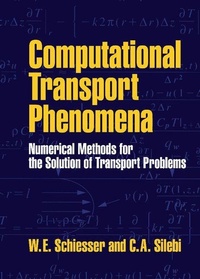
Computational Transport Phenomena
Numerical Methods for the Solution of Transport Problems
Published on 13. August 1997
Book
Hardback
470 pages
978-0-521-55378-0 (ISBN)
Description
Computational techniques have become indispensable tools in solving complex problems in transport phenomena. This book, first published in 1997, provides a clear, user-oriented introduction to the subject. Each self-contained chapter includes a detailed worked example and a discussion of the problem system equations. Also included are the numerical methods used; computer code for the solution of the problem system equations; discussion of the numerical solution with emphasis on physical interpretation; and when appropriate, a comparison of the numerical solution with an analytical solution or a discussion of how the numerical solution goes beyond what can be done analytically, especially for nonlinear problems. Intended for students and a broad range of scientists and engineers, the book includes computer code written in transportable Fortran so that readers can produce the numerical solutions and then extend them to other cases. The programs are also available on the author's web site at http://www.lehigh.edu/~wes1/wes1.html.
More details
Language
English
Place of publication
Cambridge
United Kingdom
Target group
College/higher education
Professional and scholarly
Illustrations
50 Line drawings, unspecified
Dimensions
Height: 260 mm
Width: 183 mm
Thickness: 30 mm
Weight
1072 gr
ISBN-13
978-0-521-55378-0 (9780521553780)
Copyright in bibliographic data and cover images is held by Nielsen Book Services Limited or by the publishers or by their respective licensors: all rights reserved.
Schweitzer Classification
Other editions
Additional editions
W. E. Schiesser | C. A. Silebi
Computational Transport Phenomena
Numerical Methods for the Solution of Transport Problems
Book
08/1997
Cambridge University Press
€124.60
Shipment within 15-20 days
Persons
Content
M1. Laminar boundary layer flow; M2. Unsteady laminar flow in a circular tube; M3. Nonlinear, front-sharpening convective systems; H1. Heat conduction in a semi infinite system; H2. One-dimensional heat conduction; H3. Heat transfer in a circular fin; H4. Graetz problem with constant wall heat flux; H5. Graetz problem with constant wall temperature; H6. Heat exchanger dynamics; MA1. Dynamic mass transfer model; MA2. Mass transfer with simultaneous convection and diffusion; MA3. Transient multicomponent diffusion. (M - momentum transfer; H - heat transfer; MA - mass transfer and chemical reaction).