

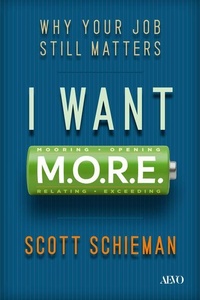
I Want M.O.R.E.
Why Your Job Still Matters
Will be published approx. on 18. August 2026
Book
Hardback
320 pages
978-1-4875-6919-8 (ISBN)
Description
Have you ever found yourself considering what your life would be like in the absence of work? Would you feel a sense of loss past the finances? More people than ever before believe that a job is just a way of earning money - nothing more. While the popularity of this transactional mindset is understandable, I Want M.O.R.E. argues that it depletes our vision of our professional lives.
Sociologist Scott Schieman has drawn upon decades of research to investigate what people think and feel about work. He has distilled the essence of that data to create M.O.R.E., which stands for Mooring, Opening, Relating, and Exceeding. Mooring navigates identity, structure, and purpose. Opening explores ability, agency, and creativity. Relating explains connection, support, and respect. And Exceeding focuses on recognition, reputation, and status.
Helping readers harness their sense of self and better their quality of life, the M.O.R.E. framework catalogues each element, along with metrics to assess your current job, what you value in a job, and what you aspire to achieve. The book also features a M.O.R.E. assessment, guidance on maximizing its dimensions, and tips for navigating difficult work situations.
A crucial guide for anyone who wants to get more out of their life and work, I Want M.O.R.E. energizes and empowers readers by encouraging a transformational new mindset about the purpose of work. How you see yourself is at the centre of who you are, and that is too important to leave to chance. And a little M.O.R.E. often produces big results.
Sociologist Scott Schieman has drawn upon decades of research to investigate what people think and feel about work. He has distilled the essence of that data to create M.O.R.E., which stands for Mooring, Opening, Relating, and Exceeding. Mooring navigates identity, structure, and purpose. Opening explores ability, agency, and creativity. Relating explains connection, support, and respect. And Exceeding focuses on recognition, reputation, and status.
Helping readers harness their sense of self and better their quality of life, the M.O.R.E. framework catalogues each element, along with metrics to assess your current job, what you value in a job, and what you aspire to achieve. The book also features a M.O.R.E. assessment, guidance on maximizing its dimensions, and tips for navigating difficult work situations.
A crucial guide for anyone who wants to get more out of their life and work, I Want M.O.R.E. energizes and empowers readers by encouraging a transformational new mindset about the purpose of work. How you see yourself is at the centre of who you are, and that is too important to leave to chance. And a little M.O.R.E. often produces big results.
More details
Language
English
Place of publication
Canada
Publishing group
University of Toronto Press
Target group
College/higher education
Professional and scholarly
Illustrations
44 illustrations
Dimensions
Height: 216 mm
Width: 140 mm
Thickness: 25 mm
Weight
1 gr
ISBN-13
978-1-4875-6919-8 (9781487569198)
Copyright in bibliographic data and cover images is held by Nielsen Book Services Limited or by the publishers or by their respective licensors: all rights reserved.
Schweitzer Classification
Person
Scott Schieman is a professor of sociology at the University of Toronto, investigating what people think and feel about work - and how they talk about it. He received the Leonard I. Pearlin Award for Distinguished Contributions to the Sociological Study of Mental Health and has committed his work to understanding how perceptions of job quality shape one's sense of self, status, and well-being.
Content
Introduction
Chapter 1. Mooring: Identity, Structure, and Purpose
Chapter 2. Opening: Ability, Agency, and Creativity
Chapter 3. Relating: Connection, Support, and Respect
Chapter 4. Exceeding: Recognition, Reputation, and Status
Chapter 1. Mooring: Identity, Structure, and Purpose
Chapter 2. Opening: Ability, Agency, and Creativity
Chapter 3. Relating: Connection, Support, and Respect
Chapter 4. Exceeding: Recognition, Reputation, and Status