

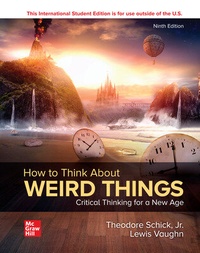
How to Think About Weird Things ISE
9th Edition
Published on 17. March 2023
Book
Paperback/Softback
384 pages
978-1-266-21925-2 (ISBN)
Description
How to Think about Weird Things is a concise and engaging text that offers students a step-by-step process by which to determine when a claim is likely to be true. Schick and Vaughn provide a course on critical thinking, with a focus on neither debunking nor advocating specific claims. Rather, the authors clarify principles of good reasoning that enable students to evaluate any claim, no matter how strange, for themselves. By teaching readers how to distinguish good reasons from bad reasons for believing a claim, this text helps students improve their decision-making abilities and provides them with a powerful weapon against all forms of hucksterism.
More details
Edition
9th edition
Language
English
Place of publication
OH
United States
Target group
College/higher education
US School Grade: From College Freshman to College Graduate Student
Illustrations
7 Illustrations
Dimensions
Height: 229 mm
Width: 160 mm
Thickness: 18 mm
Weight
436 gr
ISBN-13
978-1-266-21925-2 (9781266219252)
Copyright in bibliographic data and cover images is held by Nielsen Book Services Limited or by the publishers or by their respective licensors: all rights reserved.
Schweitzer Classification
Persons
Theodore Schick received his B.A. in philosophy from Harvard University and his Ph.D. from Brown University. He is currently professor of philosophy at Muhlenberg College where he has served as Director of Academic Computing, Director of Freshman Seminars, Director of the Muhlenberg Scholars Program, and Chair of the Philosophy Department. He is the author of Doing Philosophy: An Introduction through Thought Experiments, the editor of The Philosophy of Science: From Positivism to Post-modernism, and has published articles in several fields of philosophy including: philosophy of mind, philosophy of science, philosophy of religion, philosophy of language, meta-philosophy, epistemology, ethics, and aesthetics. He has also contributed to a number of volumes in Open Court's "Philosophy and Popular Culture" series as well as Blackwell's "Philosophy for Everyone" series.
Lewis Vaughn is the author of numerous textbooks in philosophy, critical thinking, and ethics including The Power of Critical Thinking (2019); Concise Guide to Critical Thinking (2017); Philosophy Here and Now (2019); Living Philosophy: A Historical Introduction to Philosophical Ideas (2018); Doing Ethics: Moral Reasoning, Theory, and Contemporary Issues (2019); Beginning Ethics: An Introduction to Moral Philosophy (2015); Bioethics: Principles, Issues, and Cases (2017); and Writing Philosophy (2018).
Lewis Vaughn is the author of numerous textbooks in philosophy, critical thinking, and ethics including The Power of Critical Thinking (2019); Concise Guide to Critical Thinking (2017); Philosophy Here and Now (2019); Living Philosophy: A Historical Introduction to Philosophical Ideas (2018); Doing Ethics: Moral Reasoning, Theory, and Contemporary Issues (2019); Beginning Ethics: An Introduction to Moral Philosophy (2015); Bioethics: Principles, Issues, and Cases (2017); and Writing Philosophy (2018).
Content
Chapter 1 Introduction: Close Encounters with the Strange
Chapter 2 The Possibility of the Impossible
Chapter 3 Arguments Good, Bad, and Weird
Chapter 4 Knowledge, Belief, and Evidence
Chapter 5 Looking for Truth in Personal Experience
Chapter 6 Science and Its Pretenders
Chapter 7 Case Studies in the Extraordinary
Chapter 8 Relativism, Truth, and Reality
Chapter 2 The Possibility of the Impossible
Chapter 3 Arguments Good, Bad, and Weird
Chapter 4 Knowledge, Belief, and Evidence
Chapter 5 Looking for Truth in Personal Experience
Chapter 6 Science and Its Pretenders
Chapter 7 Case Studies in the Extraordinary
Chapter 8 Relativism, Truth, and Reality