

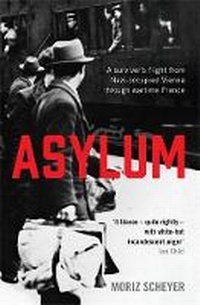
Asylum
A survivor's flight from Nazi-occupied Vienna through wartime France
Published on 6. July 2017
Book
Paperback/Softback
320 pages
978-1-78125-600-8 (ISBN)
Description
In 1943, hidden by the Resistance in a French convent, Moriz Scheyer began drafting an account of his wartime experiences: a tense, moving, at times almost miraculous story of flight and persecution in Austria and France.
As arts editor of Vienna's principal newspaper before the German annexation of Austria, Scheyer had known the city's great artists, including Stefan Zweig and Gustav Mahler, and was himself an important literary journalist. In this book he brings his distinctive critical and emotional voice to bear on his own extraordinary experiences: Vienna at the Anschluss; Paris immediately pre-war and under Nazi occupation; the 'Exodus'; two periods of incarceration in French concentration camps; contact with the Resistance; a failed attempt at escape to Switzerland; and a dramatic rescue followed by clandestine life in a mental asylum run by Franciscan nuns.
Completed in 1945, Scheyer's memoir is remarkable not just for the riveting events that it recounts, but as a near-unique survivor's perspective from that time.
As arts editor of Vienna's principal newspaper before the German annexation of Austria, Scheyer had known the city's great artists, including Stefan Zweig and Gustav Mahler, and was himself an important literary journalist. In this book he brings his distinctive critical and emotional voice to bear on his own extraordinary experiences: Vienna at the Anschluss; Paris immediately pre-war and under Nazi occupation; the 'Exodus'; two periods of incarceration in French concentration camps; contact with the Resistance; a failed attempt at escape to Switzerland; and a dramatic rescue followed by clandestine life in a mental asylum run by Franciscan nuns.
Completed in 1945, Scheyer's memoir is remarkable not just for the riveting events that it recounts, but as a near-unique survivor's perspective from that time.
Reviews / Votes
An extraordinary rediscovered manuscript, written in hiding by a friend of Stefan Zweig, which evokes the realities of the Holocaust and the French Occupation more vividly than almost anything I've read. -- Jonathan Coe "Try to understand me," Moriz Scheyer begs the future readers of his memoir in 1944. And we do, leaving it drained, but exhilarated by the description of how he roamed an unfriendly Europe, stateless. With the publication of this mesmerizing book, his search for asylum might just be over. -- Ronald C. Rosbottom, Amherst College, Author * When Paris Went Dark: The City of Light under German Occupatikon, 1940-1944 *More details
Edition
Main
Language
English
Place of publication
London
United Kingdom
Product notice
Paperback (UK-B)
Illustrations
Black and white photos
Dimensions
Height: 198 mm
Width: 129 mm
Thickness: 19 mm
Weight
268 gr
ISBN-13
978-1-78125-600-8 (9781781256008)
Copyright in bibliographic data and cover images is held by Nielsen Book Services Limited or by the publishers or by their respective licensors: all rights reserved.
Schweitzer Classification
Other editions
Additional editions
E-Book
01/2016
Profile Books Ltd
€12.49
Available for download
Persons
MORIZ SCHEYER (1886-1948) was a significant critic, essayist and travel writer, within the literary and cultural milieu of pre-war Vienna. As arts editor of the city's main newspaper, Neues Wiener Tagblatt, from 1924 until 1938, he knew such figures as Gustav Mahler and Joseph Roth, and was a personal friend of Stefan Zweig and Bruno Walter. In his lifetime he published three books inspired by his travels in the Near East and South America, as well as three volumes of literary-historical essays. Scheyer called his memoir of his wartime experiences 'A Survivor', and seems to have sought its publication. After his death in 1949, however, his stepson destroyed the manuscript. Or thought he did.
Recently Scheyer's grandson, P. N. Singer, discovered a carbon copy in his father's attic. Asylum is Singer's translation of the manuscript, to which he has added an epilogue on the people, events and context.
Learn more about Singer's family and the manuscript at www.asylumthebook.com.
Recently Scheyer's grandson, P. N. Singer, discovered a carbon copy in his father's attic. Asylum is Singer's translation of the manuscript, to which he has added an epilogue on the people, events and context.
Learn more about Singer's family and the manuscript at www.asylumthebook.com.