

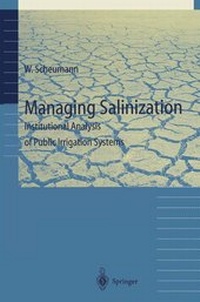
Managing Salinization
Institutional Analysis of Public Irrigation Systems
1st Edition
Published on 10. October 1997
Book
Hardback
XVI, 274 pages
978-3-540-63328-0 (ISBN)
Description
Salinization of soils is a major threat to irrigated agriculture and counteracts the targets of costly public infrastructure investments. In this study, salinization is regarded as the outcome of an institutional arrangement which impedes the effective implementation of well-known and well-established control measures be they technical, managerial or economic. In public irrigation systems neither the management units nor the farmers are offered any incentives towards the control of high groundwater levels and salinization if the management units are embedded in a highly centralized non-market institutional setting. The author answers the question under which conditions management units and irrigators are active in halting and reversing the process of salinization.
More details
Edition
1., Aufl.
Language
English
Place of publication
Berlin
Germany
Target group
College/higher education
Professional and scholarly
Environmental scientists, agronomists, political scientists, hydrologists, economists, geographers, geologists
Illustrations
36
18 s/w Abbildungen, 36 s/w Tabellen
18 figs., 36 tabs.
Dimensions
Height: 23.5 cm
Width: 15.5 cm
Weight
550 gr
ISBN-13
978-3-540-63328-0 (9783540633280)
Schweitzer Classification
Other editions
Additional editions
Book
10/2012
Springer
€53.49
Shipment within 7-9 days
Content
Theories on the Provision and Supply of Goods and Services Through Political and Bureaucratic Systems * Empirical Research on Large-Scale Public and on Small-Scale Farmer-Owned and Managed Irrigation * Effects of High Groundwater Levels, Waterlogging and Salinity on Farm Economy * Coordination and Cooperation in Multi-organizational Arrangements; Conditions for Changing Institutional Arrangements, and for Successful User Group Participation.