

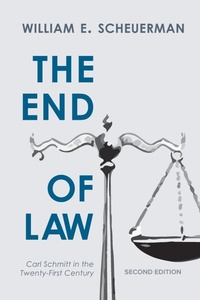
The End of Law
Carl Schmitt in the Twenty-First Century
2nd Edition
Published on 16. October 2019
Book
Paperback/Softback
358 pages
978-1-78661-155-0 (ISBN)
Description
Scholarly and political interest in the work of the controversial twentieth century German thinker Carl Schmitt has exploded in the 20 years since William E. Scheuerman's important book was first published. However, Scheuerman's work remains distinctive. Firstly, it focuses directly on Schmitt's complex ideas about law, situating his views within broader debates about the rule of law and its fate. The volume shows how every facet of his political thinking was decisively shaped by his legal reflections. Secondly, the volume takes Schmitt's Nazi-era political and legal writings no less seriously. Finally, the volume offers a series of studies on figures in postwar US political thought (Friedrich Hayek and Joseph Schumpeter), demonstrating how Schmitt shaped their own influential theories. This timely second edition underscores how and why the recent growth of interest in Schmitt has been prompted by political developments, for example, debates about counterterrorism and emergency government, and the rise of authoritarian populism.
Reviews / Votes
Twenty years ago, Scheuerman's account of Schmitt's political theory questioned the political consequences of CLS and other radical criticisms of the tradition of democratic legalism. The new chapters for this much-needed second edition take the argument further, showing how Schmitt's ideas of emergency and sovereignty undermined law and democracy in the name of one-man, patriarchal rule. -- Peter C. Caldwell, Samuel G. McCann Professor, Rice University We live in dangerous times which is why Schmitt-perhaps the most dangerous mind of the twentieth century-has proved so attractive to scholars across the political spectrum. In this update of his pathbreaking The End of Law, Scheuerman explains the power of Schmitt's insights while brilliantly exposing the hazards involved in accepting the arguments of this disingenuous academic. -- David Dyzenhaus, Professor of Law and Philosophy, University of Toronto William Scheuerman writes with almost astonishing clarity about the notably complex, controversial, and, for better or worse, undoubtedly important Carl Schmitt. The clarity extends to Scheuerman's own arguments, which allows the reader to engage in a stimulating dialogue with both Schmitt and Scheuerman. Few books are more important at the present time, when liberal democracy is under increased attack (and in need of thoughtful defenses like Scheuerman's). -- Sanford Levinson, co-author (with Jack Balkin) of Democracy and Dysfunction The key themes of Schmitt's political theory are best understood as responses to a fundamental question about legality: To what extent can and should legal or constitutional norms bind and program political decision-taking? Few books engage with Schmitt's treatment of this issue as successfully as The End of Law. The updated edition of this definitive work is highly welcome. -- Lars Vinx, Lecturer in Jurisprudence, University of Cambridge, UKMore details
Edition
2nd edition
Language
English
Place of publication
United Kingdom
Publishing group
Bloomsbury Publishing PLC
Target group
Professional and scholarly
US School Grade: From College Senior to College Graduate Student
Dimensions
Height: 229 mm
Width: 152 mm
Thickness: 21 mm
Weight
581 gr
ISBN-13
978-1-78661-155-0 (9781786611550)
Copyright in bibliographic data and cover images is held by Nielsen Book Services Limited or by the publishers or by their respective licensors: all rights reserved.
Schweitzer Classification
Other editions
Additional editions
E-Book
10/2019
2nd Edition
Rowman & Littlefield Publishers
€47.49
Available for download
Person
William E. Scheuerman is Professor of Political Science and International Studies at Indiana University.
Content
Preface
Acknowledgments
Introduction: Why Carl Schmitt?
Part One: The Jurisprudence of Lawlessness
1. The Crisis of Legal Indeterminacy
2. The Decay of Parliamentarism
3. The Critique of Liberal Constitutionalism
4. The Total State
5. After Legal Indeterminacy?
6. Indeterminacy and International Law
Epilogue to Part One: Carl Schmitt in the Aftermath of the German Catastrophe
Part Two: Carl Schmitt in America
7. Carl Schmitt and the Origins of Joseph Schumpeter's Theory of Democratic Elitism
8. The Unholy Alliance of Carl Schmitt and Friedrich A. Hayek
Part Three: Carl Schmitt's Twenty-First Century
9. States of Emergency
10. Counterterrorism
11. States of Emergency Beyond the Nation State?
Conclusion: Carl Schmitt Now?
Notes
Index
Acknowledgments
Introduction: Why Carl Schmitt?
Part One: The Jurisprudence of Lawlessness
1. The Crisis of Legal Indeterminacy
2. The Decay of Parliamentarism
3. The Critique of Liberal Constitutionalism
4. The Total State
5. After Legal Indeterminacy?
6. Indeterminacy and International Law
Epilogue to Part One: Carl Schmitt in the Aftermath of the German Catastrophe
Part Two: Carl Schmitt in America
7. Carl Schmitt and the Origins of Joseph Schumpeter's Theory of Democratic Elitism
8. The Unholy Alliance of Carl Schmitt and Friedrich A. Hayek
Part Three: Carl Schmitt's Twenty-First Century
9. States of Emergency
10. Counterterrorism
11. States of Emergency Beyond the Nation State?
Conclusion: Carl Schmitt Now?
Notes
Index