

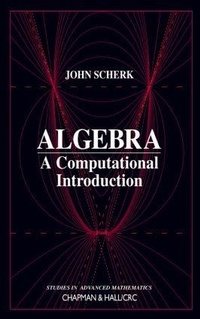
Algebra
A Computational Introduction
1st Edition
Will be published approx. on 23. June 2000
Book
Hardback
336 pages
978-1-58488-064-6 (ISBN)
Description
Adequate texts that introduce the concepts of abstract algebra are plentiful. None, however, are more suited to those needing a mathematical background for careers in engineering, computer science, the physical sciences, industry, or finance than Algebra: A Computational Introduction. Along with a unique approach and presentation, the author demonstrates how software can be used as a problem-solving tool for algebra.
A variety of factors set this text apart. Its clear exposition, with each chapter building upon the previous ones, provides greater clarity for the reader. The author first introduces permutation groups, then linear groups, before finally tackling abstract groups. He carefully motivates Galois theory by introducing Galois groups as symmetry groups. He includes many computations, both as examples and as exercises. All of this works to better prepare readers for understanding the more abstract concepts.
By carefully integrating the use of Mathematica (R) throughout the book in examples and exercises, the author helps readers develop a deeper understanding and appreciation of the material. The numerous exercises and examples along with downloads available from the Internet help establish a valuable working knowledge of Mathematica and provide a good reference for complex problems encountered in the field.
A variety of factors set this text apart. Its clear exposition, with each chapter building upon the previous ones, provides greater clarity for the reader. The author first introduces permutation groups, then linear groups, before finally tackling abstract groups. He carefully motivates Galois theory by introducing Galois groups as symmetry groups. He includes many computations, both as examples and as exercises. All of this works to better prepare readers for understanding the more abstract concepts.
By carefully integrating the use of Mathematica (R) throughout the book in examples and exercises, the author helps readers develop a deeper understanding and appreciation of the material. The numerous exercises and examples along with downloads available from the Internet help establish a valuable working knowledge of Mathematica and provide a good reference for complex problems encountered in the field.
Reviews / Votes
"... emphasizes the computational aspects of modern abstract algebra...author has integrated the software Mathematica into the discussions-especially in the group theory sections-but is careful not to make any logical reliance on this software. For one wishing to see the theory unfold through a highly computational approach, this text has much to recommend ...writing is logical but not excessively formal...I feel that this text was very courageously written...[the] focus is a bit more narrow that that of the typical first-year undergraduate course in abstract algebra. Yet, if one wishes to develop a deep and intuitive rapport with basic group and Galois theory, then this text has much to offer."--David B. Surowski, in Mathematical Reviews, Issue 2001i
More details
Series
Language
English
Place of publication
Boca Raton
United States
Publishing group
Taylor & Francis Inc
Target group
College/higher education
Undergraduate
Product notice
sewn/stitched
Illustrations
16 s/w Photographien bzw. Rasterbilder, 6 s/w Tabellen
6 Tables, black and white; 16 Halftones, black and white
Dimensions
Height: 241 mm
Width: 160 mm
Thickness: 22 mm
Weight
576 gr
ISBN-13
978-1-58488-064-6 (9781584880646)
Copyright in bibliographic data and cover images is held by Nielsen Book Services Limited or by the publishers or by their respective licensors: all rights reserved.
Schweitzer Classification
Other editions
Person
John Scherk
Content
Congruences. Permutations. Permutation Groups. Linear Groups. Groups. Subgroups. Symmetry Groups. Group Actions. Counting Formulas. Cosets. Sylow Subgroups. Simple Groups. Abelian Groups. Polynomial Rings. Symmetric Polynomials. Roots of Equations. Galois Groups. Quartics. The General Equation of the nth Degree. Solution by Radicals. Ruler-and-Compass Constructions. Appendix: Mathematica Commands.