

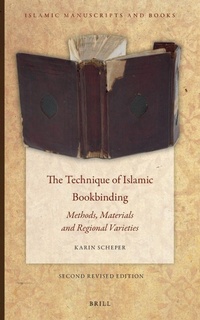
The Technique of Islamic Bookbinding
Methods, Materials and Regional Varieties. Second Revised Edition
2nd Edition
Published on 8. November 2018
Book
Hardback
456 pages
978-90-04-38548-1 (ISBN)
Description
The Technique of Islamic Bookbinding is the first monograph dedicated to the technical development of the bookbinding tradition in the Islamic world. Based on an assessment of the extensive oriental collections in the Leiden University Library, the various sewing techniques, constructions and the application of covering materials are described in great detail. A comparative analysis of the historic treatises on bookbinding provides further insight into the actual making of the Islamic book. In addition, it is demonstrated that variations in time and place can be established with the help of distinctive material characteristics.
Karin Scheper's work refutes the perception of Islamic bookbinding as a weak structure, which has generally but erroneously been typified as a case-binding. Instead, the author argues how diverse methods were used to create sound structures, thus fundamentally challenging our understanding of the Islamic bookbinding practice.
Karin Scheper has been awarded the De La Court Award 2016 by The Royal Netherlands Academy of Arts and Sciences for her study of the bookbinding tradition in the Islamic world.
Karin Scheper's work refutes the perception of Islamic bookbinding as a weak structure, which has generally but erroneously been typified as a case-binding. Instead, the author argues how diverse methods were used to create sound structures, thus fundamentally challenging our understanding of the Islamic bookbinding practice.
Karin Scheper has been awarded the De La Court Award 2016 by The Royal Netherlands Academy of Arts and Sciences for her study of the bookbinding tradition in the Islamic world.
More details
Series
Edition
2nd edition
Language
English
Place of publication
Leiden
Netherlands
Target group
Professional and scholarly
Edition type
New edition
Product notice
sewn/stitched
Cloth over boards
Dimensions
Height: 242 mm
Width: 163 mm
Thickness: 30 mm
Weight
1001 gr
ISBN-13
978-90-04-38548-1 (9789004385481)
Copyright in bibliographic data and cover images is held by Nielsen Book Services Limited or by the publishers or by their respective licensors: all rights reserved.
Schweitzer Classification
Other editions
Previous edition
Book
04/2015
2nd Edition
Brill
€187.50
Article exhausted; check for reprint
Person
Karin Scheper, Ph.D. (Leiden, 2014), is conservation specialist at the Leiden University Library. She has published on various conservation topics, but concentrates on her conservation practice and study of Islamic manuscripts.
Content
Preface to the Second Edition
Acknowledgements
Introduction
1 Materiality Matters
A Detailed Sketch of the Current State of Knowledge and Outline of the Research
?The Information Value of Binding Structures
?The Present Situation of the Book Archaeology of Islamic Manuscripts
?Obstacles in the Study of Islamic Bookmaking
?Linking Physical Analysis, Catalogue Data, and Literature
?Selection and Justification of the Corpus
2 The Anatomy of the Islamic Manuscript
A Detailed Overview of the Different Methods of Construction
?Vocabulary and Images as Tools
?Techniques Used to Construct the Textblock
?Covering and Board Attachment
?A Problematic Term: Case-binding
?Other Characteristics
?Meaning and Validity of the Diversity
3 A Comparative Study of the Historic Sources and Recent Literature on the Making of Islamic Manuscripts
?Historic Sources
?Secondary Sources: Related Studies and General Reference Works
?Founders of our Knowledge on the Use of Structure and Materials in Islamic Bookmaking
?Structure as a Starting Point
?Structure as a Side Issue
?Structure as a Conservation Issue
?The Sum of the Parts
4 Multiplicity within the Tradition
n Account of the Methodology and Quantitative Results of the Survey
?Methodology
?Survey Results-Quantitative Analysis
5 Mapping the Variations in Time and Place
Datable and Localisable Features and a Further Interpretation of the Findings
?Sewing
?Spine-lining
?Endbanding
?Covering
?Spine-endings
?Interior Covering of the Boards
?The Envelope and Fore-edge Flap
?Miscellaneous Features
?Southeast Asia as a Sub-category in the Islamic Tradition
?Summary
6 Considerations and New Perspectives
?Recapitulation
?Development of the Tradition
?Discussion
?Conclusion
Appendices
1 Glossary
2 Corpus
3 Example of a Record of the Database
4 List of Manuscripts Used in Illustrations
Bibliography
Index
Acknowledgements
Introduction
1 Materiality Matters
A Detailed Sketch of the Current State of Knowledge and Outline of the Research
?The Information Value of Binding Structures
?The Present Situation of the Book Archaeology of Islamic Manuscripts
?Obstacles in the Study of Islamic Bookmaking
?Linking Physical Analysis, Catalogue Data, and Literature
?Selection and Justification of the Corpus
2 The Anatomy of the Islamic Manuscript
A Detailed Overview of the Different Methods of Construction
?Vocabulary and Images as Tools
?Techniques Used to Construct the Textblock
?Covering and Board Attachment
?A Problematic Term: Case-binding
?Other Characteristics
?Meaning and Validity of the Diversity
3 A Comparative Study of the Historic Sources and Recent Literature on the Making of Islamic Manuscripts
?Historic Sources
?Secondary Sources: Related Studies and General Reference Works
?Founders of our Knowledge on the Use of Structure and Materials in Islamic Bookmaking
?Structure as a Starting Point
?Structure as a Side Issue
?Structure as a Conservation Issue
?The Sum of the Parts
4 Multiplicity within the Tradition
n Account of the Methodology and Quantitative Results of the Survey
?Methodology
?Survey Results-Quantitative Analysis
5 Mapping the Variations in Time and Place
Datable and Localisable Features and a Further Interpretation of the Findings
?Sewing
?Spine-lining
?Endbanding
?Covering
?Spine-endings
?Interior Covering of the Boards
?The Envelope and Fore-edge Flap
?Miscellaneous Features
?Southeast Asia as a Sub-category in the Islamic Tradition
?Summary
6 Considerations and New Perspectives
?Recapitulation
?Development of the Tradition
?Discussion
?Conclusion
Appendices
1 Glossary
2 Corpus
3 Example of a Record of the Database
4 List of Manuscripts Used in Illustrations
Bibliography
Index