

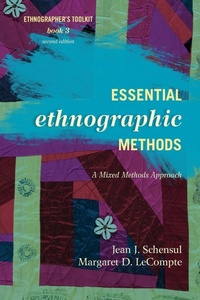
Essential Ethnographic Methods
A Mixed Methods Approach
2nd Edition
Published on 1. October 2012
Book
Paperback/Softback
386 pages
978-0-7591-2203-1 (ISBN)
Description
This is Book 3 of 7 in the Ethnographer's Toolkit, Second Edition.
Essential Ethnographic Methods introduces the fundamental, face-to-face data collection tools that ethnographers and other qualitative researchers use on a regular basis. It provides ethnographers with tools to answer the principal ethnographic questions about setting, participants, activities, behavior, and more. The essential "mixed" methods for collecting data include open-ended and focused listening, questioning strategies, participant and non-participant observation, recording techniques, visual recall, mapping the environments and contexts in which participant behavior occurs, and engaging in ethnographically informed survey research. Because these data collection strategies require ethnographers to become involved in the local cultural setting and to acquire their experience through hands-on experience, the essential tools also allow them to learn about new situations from the perspective of an "insider." With these detailed instructions, the quality and scope of the data ethnographers collect are sure to be improved.
Other books in the set:
Book 1:
Designing and Conducting Ethnographic Research: An Introduction, Second Edition
by Margaret D. LeCompte and Jean J. Schensul
9780759118690
Book 2:
Initiating Ethnographic Research: A Mixed Methods Approach
by Stephen L. Schensul, Jean J. Schensul, and Margaret D. LeCompte
9780759122017
Book 4:
Specialized Ethnographic Methods: A Mixed Methods Approach
edited by Jean J. Schensul and Margaret D. LeCompte
9780759122055
Book 5:
Analysis and Interpretation of Ethnographic Data: A Mixed Methods Approach, Second Edition
by Margaret D. LeCompte and Jean J. Schensul
9780759122079
Book 6:
Ethics in Ethnography: A Mixed Methods Approach
by Margaret D. LeCompte and Jean J. Schensul
9780759122093
Book 7:
Ethnography in Action: A Mixed Methods Approach
by Jean J. Schensul and Margaret D. LeCompte
9780759122116
Essential Ethnographic Methods introduces the fundamental, face-to-face data collection tools that ethnographers and other qualitative researchers use on a regular basis. It provides ethnographers with tools to answer the principal ethnographic questions about setting, participants, activities, behavior, and more. The essential "mixed" methods for collecting data include open-ended and focused listening, questioning strategies, participant and non-participant observation, recording techniques, visual recall, mapping the environments and contexts in which participant behavior occurs, and engaging in ethnographically informed survey research. Because these data collection strategies require ethnographers to become involved in the local cultural setting and to acquire their experience through hands-on experience, the essential tools also allow them to learn about new situations from the perspective of an "insider." With these detailed instructions, the quality and scope of the data ethnographers collect are sure to be improved.
Other books in the set:
Book 1:
Designing and Conducting Ethnographic Research: An Introduction, Second Edition
by Margaret D. LeCompte and Jean J. Schensul
9780759118690
Book 2:
Initiating Ethnographic Research: A Mixed Methods Approach
by Stephen L. Schensul, Jean J. Schensul, and Margaret D. LeCompte
9780759122017
Book 4:
Specialized Ethnographic Methods: A Mixed Methods Approach
edited by Jean J. Schensul and Margaret D. LeCompte
9780759122055
Book 5:
Analysis and Interpretation of Ethnographic Data: A Mixed Methods Approach, Second Edition
by Margaret D. LeCompte and Jean J. Schensul
9780759122079
Book 6:
Ethics in Ethnography: A Mixed Methods Approach
by Margaret D. LeCompte and Jean J. Schensul
9780759122093
Book 7:
Ethnography in Action: A Mixed Methods Approach
by Jean J. Schensul and Margaret D. LeCompte
9780759122116
More details
Series
Edition
2nd edition
Language
English
Place of publication
California
United States
Target group
College/higher education
Professional and scholarly
Dimensions
Height: 229 mm
Width: 152 mm
Thickness: 21 mm
Weight
561 gr
ISBN-13
978-0-7591-2203-1 (9780759122031)
Copyright in bibliographic data and cover images is held by Nielsen Book Services Limited or by the publishers or by their respective licensors: all rights reserved.
Schweitzer Classification
Other editions
Additional editions
E-Book
10/2012
2nd Edition
AltaMira Press
€47.49
Available for download
E-Book
10/2012
2nd Edition
Bloomsbury eBooks US
€47.49
Available for download
Persons
Jean J. Schensul is founding director and senior scientist at the Institute for Community Research, Hartford, Connecticut.
Margaret D. LeCompte is professor emerita of education and sociology at the University of Colorado, Boulder.
Margaret D. LeCompte is professor emerita of education and sociology at the University of Colorado, Boulder.
Content
List of Tables and Figures
List of Examples
Introduction
Chapter 1 Essential Data Collection
Chapter 2 Defining and Entering the Field
Chapter 3 Recording and Organizing Ethnographic Field Data: Field Notes, Interviews, Drawings, Visual Documentation, and Survey Data
Chapter 4 Participant Observation and Informal Field Interviewing
Chapter 5 Additional Methods for Collecting Exploratory Data
Chapter 6 In-depth, Open-ended Exploratory Interviews
Chapter 7 Semi-structured Interviews and Observations
Chapter 8 Focus Group Interviews
Chapter 9 Structured Approaches to Ethnographic Data Collection: Surveys
Chapter 10 Sampling in Ethnographic Research
Chapter 11 Defining and Evaluating Quality in Ethnographic Research
References
Index
About the Authors
List of Examples
Introduction
Chapter 1 Essential Data Collection
Chapter 2 Defining and Entering the Field
Chapter 3 Recording and Organizing Ethnographic Field Data: Field Notes, Interviews, Drawings, Visual Documentation, and Survey Data
Chapter 4 Participant Observation and Informal Field Interviewing
Chapter 5 Additional Methods for Collecting Exploratory Data
Chapter 6 In-depth, Open-ended Exploratory Interviews
Chapter 7 Semi-structured Interviews and Observations
Chapter 8 Focus Group Interviews
Chapter 9 Structured Approaches to Ethnographic Data Collection: Surveys
Chapter 10 Sampling in Ethnographic Research
Chapter 11 Defining and Evaluating Quality in Ethnographic Research
References
Index
About the Authors