

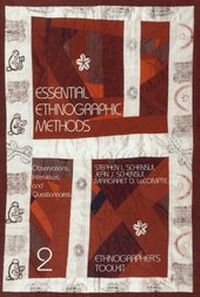
Essential Ethnographic Methods: Observations, Interviews, and Questionnaires
Observations, Interviews, and Questionnaires
Published on 1. August 1999
Book
Paperback/Softback
318 pages
978-0-7619-9144-1 (ISBN)
Description
A newer edition of this book is available for ordering at the following web address: https://rowman.com/ISBN/9780759122017 Like all books in the Ethnographer's Toolkit, Book 2, Essential Ethnographic Methods, takes a mixed methods approach to introducing the fundamental, face-to-face data collection tools that ethnographers and other qualitative researchers use. Book 3 provides ethnographers with tools to answer basic ethnographic questions about the setting, activities, behavior, communication patterns of participants, and more. It teaches readers how to do good ethnography by walking them through the required steps for each essential method, and supplements this information with hands-on materials and illustrative case examples. Because these data collection strategies require ethnographers to become involved in the local cultural setting and to acquire hands-on experience, the essential tools also help them learn about new situations from the perspective of an "insider."
The chapters cover open-ended and focused listening, questioning strategies, participant and non-participant observation, recording techniques, visual recall, strategies for mapping the environments and contexts in which participant behavior occurs, and varied approaches to individual- and group-level in-depth interviewing. Unlike most methods texts, Book 3 also examines how and why to carry out ethnographically informed qualitative and quantitative survey research. It also provides the basis for quantification of qualitative research for those who wish to do so. Research methods are sequenced in accordance with early, middle, and later stages of a research project, making it easy for readers to select different data collection methods for specific purposes and timelines. This mixed methods approach is emphasized because it is the only way that are ethnographers able to obtain the holistic portrayal of dynamic social systems and cultural phenomena that characterize the best ethnographies.
The chapters cover open-ended and focused listening, questioning strategies, participant and non-participant observation, recording techniques, visual recall, strategies for mapping the environments and contexts in which participant behavior occurs, and varied approaches to individual- and group-level in-depth interviewing. Unlike most methods texts, Book 3 also examines how and why to carry out ethnographically informed qualitative and quantitative survey research. It also provides the basis for quantification of qualitative research for those who wish to do so. Research methods are sequenced in accordance with early, middle, and later stages of a research project, making it easy for readers to select different data collection methods for specific purposes and timelines. This mixed methods approach is emphasized because it is the only way that are ethnographers able to obtain the holistic portrayal of dynamic social systems and cultural phenomena that characterize the best ethnographies.
More details
Persons
Jean S. Schensul is founding director and senior scientist at the Institute for Community Research, Hartford, Connecticut. Margaret D. LeCompte is professor emerita of education and sociology at the University of Colorado, Boulder.
Content
chapter 1 Introduction chapter 2 1. Conceptualizing Ethnographic Research chapter 3 2. Operationalization chapter 4 3. Unstructured Interviewing and Observation chapter 5 4. Semi-structured Interviewing and Observation chapter 6 5. The Ethnographic Survey chapter 7 6. Accessing Archival Data chapter 8 7. Triangulating chapter 9 About the Authors, Artists, and Editors chapter 10 Index