

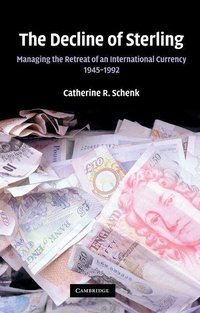
The Decline of Sterling
Managing the Retreat of an International Currency, 1945-1992
Published on 18. July 2013
Book
Paperback/Softback
464 pages
978-1-107-61299-0 (ISBN)
Description
The demise of sterling as an international currency was widely predicted after 1945, but the process took thirty years to complete. Why was this demise so prolonged? Traditional explanations emphasize British efforts to prolong sterling's role because it increased the capacity to borrow, enhanced prestige, or supported London as a centre for international finance. This book challenges this view by arguing that sterling's international role was prolonged by the weakness of the international monetary system and by collective global interest in its continuation. Using the archives of Britain's partners in Europe, the USA and the Commonwealth, Catherine Schenk shows how the UK was able to convince other governments that sterling's international role was critical for the stability of the international economy and thereby attract considerable support to manage its retreat. This revised view has important implications for current debates over the future of the US dollar as an international currency.
Reviews / Votes
'Catherine Schenk tells the story of the changing fortunes of sterling across the second half of the twentieth century. This ranges over everything from convertibility, reserve currencies, sterling balances, the euro-currency markets, the international financial architecture, and a great deal more. Sterling has also been placed in the context of the international monetary system, and in the context of the growing literature on the economic and wider history of the period. It is an excellent account of difficult territory.' Forrest Capie, Cass Business School and Official Historian of the Bank of England 'Anyone concerned about how to resolve the global imbalances in the international economy today needs to read Catherine Schenk's detailed study of the political and economic difficulties that bedevilled Britain's decades-long effort to eliminate the 'sterling problem' left over from World War II. Her detailed analysis of the issues that confronted British policymakers and how they were resolved shows how hard it is to correct global imbalances once they exist, even with the best of intentions and international cooperation. For, even if the stakes diminish over time, as they did with British sterling, the stake holders and their interests keep changing as well.' Larry Neal, University of Illinois, Urbana-ChampaignMore details
Language
English
Place of publication
Cambridge
United Kingdom
Target group
Professional and scholarly
Product notice
Paperback (trade)
Illustrations
Printed music items
Dimensions
Height: 229 mm
Width: 152 mm
Thickness: 25 mm
Weight
667 gr
ISBN-13
978-1-107-61299-0 (9781107612990)
Copyright in bibliographic data and cover images is held by Nielsen Book Services Limited or by the publishers or by their respective licensors: all rights reserved.
Schweitzer Classification
Other editions
Additional editions
Catherine R. Schenk
The Decline of Sterling
Managing the Retreat of an International Currency, 1945-1992
Book
05/2010
1st Edition
Cambridge University Press
€167.50
Shipment within 15-20 days
Catherine R. Schenk
The Decline of Sterling
Managing the Retreat of an International Currency, 1945-1992
E-Book
04/2010
1st Edition
Cambridge University Press
€44.49
Available for download
Person
Catherine R. Schenk is Professor of International Economic History at the University of Glasgow. She has held academic posts in the UK, New Zealand and Malaysia and has been a visiting researcher at the Hong Kong Institute for Monetary Research and the International Monetary Fund. Her previous books include Hong Kong as an International Financial Centre (2001) and Britain and the Sterling Area (1994).
Content
List of figures; List of tables; Acknowledgements; 1. Introduction and outline of the book; Part I. Reconstructing the International Monetary System 1945-59: 2. The post-war international monetary system 1945-50; 3. Return to convertibility 1950-9; Part II. Accelerating the Retreat: Sterling in the 1960s: 4. Sterling and European integration; 5. The sterling devaluation 1967: relations with the USA and the IMF; 6. Sterling and the City; 7. Multilateral negotiations: sterling and the reform of the international monetary system; 8. The sterling agreements of 1968; Part III. Sterling's Final Retreat 1970-92: 9. Sterling and the end of Bretton Woods; 10. Years of crisis 1973-9; 11. The aftermath 1980-92; 12. Summary and conclusions; Index.