

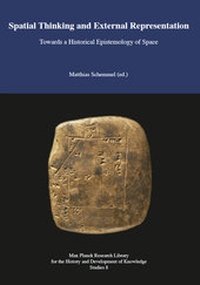
Spatial Thinking and External Representation
Towards a Historical Epistemology of Space - Max Planck Research Library for the History and Development of Knowledge - Studies 8
1st Edition
Published on 10. November 2016
Book
Paperback/Softback
219 pages
978-3-945561-08-9 (ISBN)
Description
Spatial thinking plays a central role in the life of individuals
as well as whole societies. It ranges from everyday orientation
in our living environment to the social organization of place and
space and the structuring of a huge corpus of experiential
knowledge by means of theoretical concepts in modern science.
Spatial knowledge thereby takes on different forms in different
contexts, and it does so depending on the spatial experiences
accounted for and the available means for its external
representation. From this perspective, scientific spatial
knowledge is but one form of spatial knowledge and does not
represent a Stratum independent from non-scientific knowledge.
This volume presents and analyses manifestations of spatial
thinking in various societal and historical circumstances: in the
language and practices of recent non-literate societies, in the
administrative institutions of early civilizations, in discursive
contexts of ancient Greece and China, in early modern natural
philosophy and metaphysics, and in twentieth-century physics. It
discusses the historical and structural relations of the
different forms of spatial knowledge and thereby attempts to
address the question of the epistemic status of this knowledge.
The series Studies of the Max Planck Research Library for the
History and Development of Knowledge is dedicated to key subjects
in the history and development of knowledge, bringing together
perspectives from different fields and combining source-based
empirical research with theoretically guided approaches. Studies
typically present working group volumes with integrative
approaches. The volumes are available both as print-on-demand
books and as open-access publications on the Internet. The
material is freely accessible online at www.edition-open-access.de.
as well as whole societies. It ranges from everyday orientation
in our living environment to the social organization of place and
space and the structuring of a huge corpus of experiential
knowledge by means of theoretical concepts in modern science.
Spatial knowledge thereby takes on different forms in different
contexts, and it does so depending on the spatial experiences
accounted for and the available means for its external
representation. From this perspective, scientific spatial
knowledge is but one form of spatial knowledge and does not
represent a Stratum independent from non-scientific knowledge.
This volume presents and analyses manifestations of spatial
thinking in various societal and historical circumstances: in the
language and practices of recent non-literate societies, in the
administrative institutions of early civilizations, in discursive
contexts of ancient Greece and China, in early modern natural
philosophy and metaphysics, and in twentieth-century physics. It
discusses the historical and structural relations of the
different forms of spatial knowledge and thereby attempts to
address the question of the epistemic status of this knowledge.
The series Studies of the Max Planck Research Library for the
History and Development of Knowledge is dedicated to key subjects
in the history and development of knowledge, bringing together
perspectives from different fields and combining source-based
empirical research with theoretically guided approaches. Studies
typically present working group volumes with integrative
approaches. The volumes are available both as print-on-demand
books and as open-access publications on the Internet. The
material is freely accessible online at www.edition-open-access.de.
More details
Content
- Preface
- Towards a Historical Epistemology of Space: An Introduction (Matthias Schemmel)
- Spatial Concepts in Non-Literate Societies: Language and Practice in Eipo and Dene Chipewyan (Martin Thiering and Wulf Schiefenhövel)
- The Impact of Notation Systems: From the Practical Knowledge of Surveyors to Babylonian Geometry (Peter Damerow)
- Theoretical Reflections on Elementary Actions and Instrumental Practices: The Example of the Mohist Canon (William G. Boltz and Matthias Schemmel)
- Cosmology and Epistemology: A Comparison between Aristotle's and Ptolemy's Approaches to Geocentrism (Pietro Daniel Omodeo and Irina Tupikova)
- Space and Matter in Early Modern Science: The Impenetrability of Matter (Peter Damerow)
- Experience and Representation in Modern Physics: The Reshaping of Space (Alexander Blum, Jürgen Renn and Matthias Schemmel)