

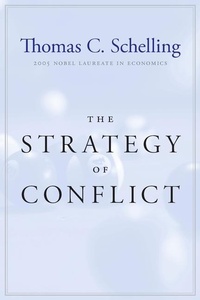
The Strategy of Conflict
With a New Preface by the Author
2nd Edition
Published on 15. May 1981
Book
Paperback/Softback
328 pages
978-0-674-84031-7 (ISBN)
Description
A series of closely interrelated essays on game theory, this book deals with an area in which progress has been least satisfactory-the situations where there is a common interest as well as conflict between adversaries: negotiations, war and threats of war, criminal deterrence, extortion, tacit bargaining. It proposes enlightening similarities between, for instance, maneuvering in limited war and in a traffic jam; deterring the Russians and one's own children; the modern strategy of terror and the ancient institution of hostages.
Reviews / Votes
Against the backdrop of the nuclear arms race in the late 1950s, Thomas Schelling's book The Strategy of Conflict set forth his vision of game theory as a unifying framework for the social sciences. Schelling showed that a party can strengthen its position by overtly worsening its own options, that the capability to retaliate can be more useful than the ability to resist an attack, and that uncertain retaliation is more credible and more efficient than certain retaliation. These insights have proven to be of great relevance for conflict resolution and efforts to avoid war. Schelling's work prompted new developments in game theory and accelerated its use and application throughout the social sciences. Notably, his analysis of strategic commitments has explained a wide range of phenomena, from the competitive strategies of firms to the delegation of political decision power. -- The Royal Swedish Academy of Sciences In eminently lucid and often charming language, Professor Schelling's work opens to rational analysis a crucial field of politics, the international politics of threat, or as the current term goes, of deterrence. In this field, the author's analysis goes beyond what has been done by earlier writers. It is the best, most incisive, and most stimulating book on the subject. * Annals of the American Academy * An important contribution to understanding the conduct of the ambiguous conflict between the communist bloc on the one hand and the United States and its Free World Allies on the other. * Journal of Politics *More details
Edition
2nd edition
Language
English
Place of publication
Cambridge, Mass
United States
Target group
College/higher education
Professional and scholarly
Illustrations
36 line illustrations
Dimensions
Height: 204 mm
Width: 138 mm
Thickness: 21 mm
Weight
416 gr
ISBN-13
978-0-674-84031-7 (9780674840317)
Copyright in bibliographic data and cover images is held by Nielsen Book Services Limited or by the publishers or by their respective licensors: all rights reserved.
Schweitzer Classification
Other editions
Additional editions
E-Book
05/1981
1st Edition
Harvard University Press
€76.99
Available for download
Person
Thomas C. Schelling was Distinguished University Professor in the Department of Economics and School of Public Affairs at the University of Maryland and Lucius N. Littauer Professor of Political Economy, Emeritus, at Harvard University. He was co-recipient of the 2005 Nobel Prize in Economics.
Content
I. Elements of a Theory of Strategy 1. The Retarded Science of International Strategy 2. An Essay on Bargaining 3. Bargaining, Communication, and Limited War II. A Reorientation of Game Theory 4. Toward a Theory of Interdependent Decision 5. Enforcement, Communication, and Strategic Moves 6. Game Theory and Experimental Research III. Strategy with a Random Ingredient 7. Randomization of Promises and Threats 8. The Threat That Leaves Something to Chance IV. Surprise Attack: A Study in Mutual Distrust 9. The Reciprocal Fear of Surprise Attack 10. Surprise Attack and Disarmament Appendices A. Nuclear Weapons and Limited War B. For the Abandonment of Symmetry in Game Theory C. Re-interpretation of a Solution Concept for "Noncooperative" Games Index