

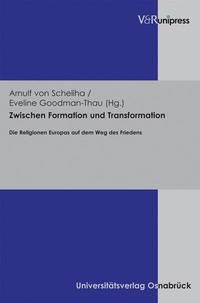
Zwischen Formation und Transformation
Die Religionen Europas auf dem Weg des Friedens
1st Edition
Published on 20. April 2011
Book
Hardback
240 pages
978-3-89971-839-3 (ISBN)
Description
European religious culture of the future will be determined by the co-existence of the Christian confessions, Judaism and Islam. What potential for a peaceful arrangement do these three religions hold? What historical periods can we thereby build on? In what way will the interpretation of religious sources be altered by the tasks attendant to a unified Europe? The volume comprises reflections on prerequisites, framework conditions and practical consequences for peaceful co-existence between religions from philosophical, politological, legal, historical, theological and inter-religious perspectives. The main focus of interest is on the transformation processes that the religions must undergo if they wish to participate constructively from now on in the discourse on the cultural identity of Europe.
More details
Other editions
Additional editions
Arnulf von Scheliha | Eveline Goodman-Thau
Zwischen Formation und Transformation
Die Religionen Europas auf dem Weg des Friedens
E-Book
04/2011
1st Edition
V&R unipress
€59.00
Available for download
Persons
Editor
Prof. Dr. Arnulf von Scheliha lehrt Systematische Theologie an der Universität Osnabrück.
Prof. Dr. Dr. h.c. Eveline Goodman-Thau (Jerusalem) ist Direktorin der Hermann-Cohen-Akademie. Im Sommersemester 2010 hatte sie eine Gastprofessur für Frieden und globale Gerechtigkeit an der Universität Osnabrück inne.
Contributions
Dr. Görge K. Hasselhoff war u.a. Research Fellow an der Universität Bochum, hatte Gastprofessuren und Lehrstuhlvertretungen in Brasilien, Potsdam und Katalonien inne und lehrt gegenwärtig als Privatdozent an der TU Dortmund.
Content
European religious culture of the future will be determined by the co-existence of the Christian confessions, Judaism and Islam. What potential for a peaceful arrangement do these three religions hold? What historical periods can we thereby build on? In what way will the interpretation of religious sources be altered by the tasks attendant to a unified Europe? The volume comprises reflections on prerequisites, framework conditions and practical consequences for peaceful co-existence between religions from philosophical, politological, legal, historical, theological and inter-religious perspectives. The main focus of interest is on the transformation processes that the religions must undergo if they wish to participate constructively from now on in the discourse on the cultural identity of Europe.>