

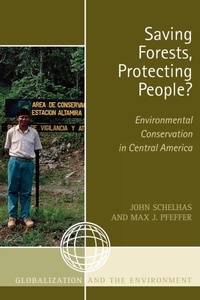
Saving Forests, Protecting People?
Environmental Conservation in Central America
Published on 16. March 2009
Book
Paperback/Softback
330 pages
978-0-7591-0947-6 (ISBN)
Description
Tropical forest conservation is attracting widespread public interest and helping to shape the ways in which environmental scientists and other groups approach global environmental issues. Schelhas and Pfeffer show that globally-driven forest conservation efforts have had different results in different places, ranging from violent protest to the discovery of common ground among conservation programs and the various interests of local peoples. The authors examine the connections between local values, material needs, and environmental management regimes. Saving Forests, Protecting People? explores that difficult terrain where culture, the environment, and social policies meet.
Reviews / Votes
What happens when global concerns about conserving forests and wildlife run up against the reality that people rely on those resources to make a living? Schelhas and Pfeffer examine how rural communities in Costa Rica and Honduras think about forests and conservation-and they find that global discourses about the environment have reached the farthest corners of the earth, though local people reinterpret them to meet their needs. Saving Forests, Protecting People? brings these processes sharply into focus, which is essential if we are to find realistic solutions to the problems of conservation. -- David Kaimowitz, Ford Foundation Schelhas and Pfeffer have written an engaging and unique book that fills an important niche in our understanding of the intersection of global and local values in tropical forest conservation. -- Steven R. Brechin, Syracuse University The authors offer a realistic, penetrating analysis of the values and motivations that shape local response to government policies....Highly recommended. * Choice Reviews * Shines a welcome light on the changing attitudes of poor rural peoples toward newly created parks near their homes. It is a 'must read' for anyone concerned about preserving biodiversity in the tropics. -- Thomas K. Rudel, Rutgers University The book is divided into five chapters....This organization makes the book useful to a wide audience, including forest and protected area policy makers, the interested public, researchers, faculty and students alike. Additionally, because it contextualizes parks and protected areas both locally and globally, it would be an ideal analysis for use as an environment anthropology, or as a supplement in a forestry or other natural resource management and policy course. * Agric Hum Values *More details
Series
Language
English
Place of publication
California
United States
Target group
College/higher education
Professional and scholarly
Dimensions
Height: 229 mm
Width: 152 mm
Thickness: 18 mm
Weight
482 gr
ISBN-13
978-0-7591-0947-6 (9780759109476)
Copyright in bibliographic data and cover images is held by Nielsen Book Services Limited or by the publishers or by their respective licensors: all rights reserved.
Schweitzer Classification
Persons
John Schelhas is research forester with the Southern Research Station of the USDA Forest Service stationed at Tuskegee University in Alabama. Max J. Pfeffer is International Professor of Development Sociology and chair of the Department of Development Sociology at Cornell University.
Content
Preface
Introduction: Parks and protected areas in the process of environmental globalization
Study Sites
Diverse cultural models to manage competing interests in natural resource use in Costa Rica
Forest conservation, park management, and value change in Honduras
Conclusion: Situating environmental values in a globalizing world
Appendices 1-5
Introduction: Parks and protected areas in the process of environmental globalization
Study Sites
Diverse cultural models to manage competing interests in natural resource use in Costa Rica
Forest conservation, park management, and value change in Honduras
Conclusion: Situating environmental values in a globalizing world
Appendices 1-5