

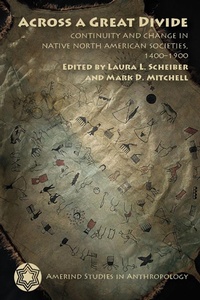
Across a Great Divide
Continuity and Change in Native North American Societies, 1400-1900
Will be published approx. on 30. June 2015
Book
Paperback/Softback
352 pages
978-0-8165-3208-7 (ISBN)
Description
Archaeological research is uniquely positioned to show how native history and native culture affected the course of colonial interaction, but to do so it must transcend colonialist ideas about Native American technological and social change. This book applies that insight to five hundred years of native history. Using data from a wide variety of geographical, temporal, and cultural settings, the contributors examine economic, social, and political stability and transformation in indigenous societies before and after the advent of Europeans and document the diversity of native colonial experiences. The book's case studies range widely, from sixteenth-century Florida, to the Great Plains, to nineteenth-century coastal Alaska.
The contributors address a series of interlocking themes. Several consider the role of indigenous agency in the processes of colonial interaction, paying particular attention to gender and status. Others examine the ways long-standing native political economies affected, and were in turn affected by, colonial interaction. A third group explores colonial-period ethnogenesis, emphasizing the emergence of new native social identities and relations after 1500. The book also highlights tensions between the detailed study of local cases and the search for global processes, a recurrent theme in postcolonial research.
If archaeologists are to bridge the artificial divide separating history from prehistory, they must overturn a whole range of colonial ideas about American Indians and their history. This book shows that empirical archaeological research can help replace long-standing models of indigenous culture change rooted in colonialist narratives with more nuanced, multilinear models of change and play a major role in decolonizing knowledge about native peoples.
The contributors address a series of interlocking themes. Several consider the role of indigenous agency in the processes of colonial interaction, paying particular attention to gender and status. Others examine the ways long-standing native political economies affected, and were in turn affected by, colonial interaction. A third group explores colonial-period ethnogenesis, emphasizing the emergence of new native social identities and relations after 1500. The book also highlights tensions between the detailed study of local cases and the search for global processes, a recurrent theme in postcolonial research.
If archaeologists are to bridge the artificial divide separating history from prehistory, they must overturn a whole range of colonial ideas about American Indians and their history. This book shows that empirical archaeological research can help replace long-standing models of indigenous culture change rooted in colonialist narratives with more nuanced, multilinear models of change and play a major role in decolonizing knowledge about native peoples.
More details
Series
Language
English
Place of publication
Tucson
United States
Target group
College/higher education
Product notice
Paperback (trade)
Unsewn / adhesive bound
Dimensions
Height: 226 mm
Width: 150 mm
Thickness: 20 mm
Weight
476 gr
ISBN-13
978-0-8165-3208-7 (9780816532087)
Copyright in bibliographic data and cover images is held by Nielsen Book Services Limited or by the publishers or by their respective licensors: all rights reserved.
Schweitzer Classification
Persons
Laura L. Scheiber is an assistant professor of anthropology at Indiana University, USA and co-editor of Archaeological Landscapes on the High Plains.
Mark D. Mitchell is a PhD candidate in anthropology at the University of Colorado, USA.
Mark D. Mitchell is a PhD candidate in anthropology at the University of Colorado, USA.