

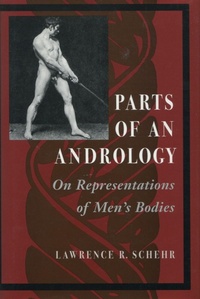
Parts of an Andrology
On Representations of Men's Bodies
Published on 1. August 1997
Book
Paperback/Softback
280 pages
978-0-8047-2920-8 (ISBN)
Description
The subject of this original and provocative work is the white male body, a counterpoint in gender studies to the many readings of the representation of the female body. To look at the construction of this figure, the author examines a group of discontinuous works that are representative of the discontinuity in the intermittent representation of the male body.
Especially in nineteenth-century narrative, where Edgar Allan Poe and Guy de Maupassant write astutely on the subject, there is never continuity in representing the male body. "The Pit and the Pendulum" and Bel-Ami are flickering, episodic investigations into the male body as subject, as sentient feeling, as the subject of torture or of adulation. Not until the twentieth century can this male subject be continuously represented. Though the male body is often at center stage, in works that treat it as a metonymy of its own phallic and phallocentric power, this body has less often been seen relative to pleasure and pain, to aesthetics, to human vulnerability.
An introductory chapter explores a work by Alberto Moravia, Io e lui, as well as various manifestations of the male body's most salient part, the penis, in contemporary discourse and aesthetics. Another chapter deals with writings about the forbidden activity of masturbation and focuses on the work of three disparate writers: Paul Bonnetain, Michel Tournier, and Philip Roth.
In the final chapter, the author discusses several works that focus on the representation of the male body during the gay liberation movement in France and the subsequent celebration of the male body, ending with the inscription of the male body in the literature of AIDS. Among the authors discussed are Guy Hocquenghem, Herve Guibert, and Michel Foucault.
Especially in nineteenth-century narrative, where Edgar Allan Poe and Guy de Maupassant write astutely on the subject, there is never continuity in representing the male body. "The Pit and the Pendulum" and Bel-Ami are flickering, episodic investigations into the male body as subject, as sentient feeling, as the subject of torture or of adulation. Not until the twentieth century can this male subject be continuously represented. Though the male body is often at center stage, in works that treat it as a metonymy of its own phallic and phallocentric power, this body has less often been seen relative to pleasure and pain, to aesthetics, to human vulnerability.
An introductory chapter explores a work by Alberto Moravia, Io e lui, as well as various manifestations of the male body's most salient part, the penis, in contemporary discourse and aesthetics. Another chapter deals with writings about the forbidden activity of masturbation and focuses on the work of three disparate writers: Paul Bonnetain, Michel Tournier, and Philip Roth.
In the final chapter, the author discusses several works that focus on the representation of the male body during the gay liberation movement in France and the subsequent celebration of the male body, ending with the inscription of the male body in the literature of AIDS. Among the authors discussed are Guy Hocquenghem, Herve Guibert, and Michel Foucault.
Reviews / Votes
"This outstanding work is of vital importance to several related fields: sexuality studies (lesbian and gay), gender studies (masculinist and feminist), cultural studies, critical theory, and literary criticism. The scholarship is superb, as Schehr factors the entire oeuvres of the authors discussed as well as the author's critical receptions into his own discussions. He is, moreover, a cutting-edge literary theorist who happens to know his history (literary as well as political)-a rare combination." -Kevin Kopelson,University of IowaMore details
Edition
New edition
Language
English
Place of publication
Palo Alto
United States
Target group
College/higher education
Professional and scholarly
Edition type
New edition
Product notice
Paperback (trade)
Dimensions
Height: 216 mm
Width: 139 mm
Thickness: 13 mm
Weight
304 gr
ISBN-13
978-0-8047-2920-8 (9780804729208)
Copyright in bibliographic data and cover images is held by Nielsen Book Services Limited or by the publishers or by their respective licensors: all rights reserved.
Schweitzer Classification
Content
1. Introduction: on plemystography; 2. Designing men; 3. The writer's hand; 4. From liberation to AIDS; Notes; Bibliography; Index.