

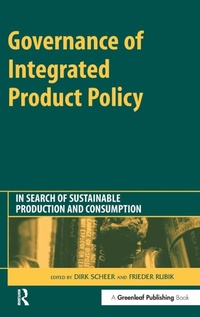
Governance of Integrated Product Policy
In Search of Sustainable Production and Consumption
1st Edition
Published on 1. February 2006
Book
Hardback
377 pages
978-1-874719-32-8 (ISBN)
Description
European policy patterns are in a state of transformation. New governance models are shifting power away from states and toward the involvement of all stakeholders and the idea of shared responsibility. It's a move from command and control to push and pull.
What's in this new approach for the environment? This book provides a detailed analysis of the example of integrated product policy (IPP) which aims to improve the environmental performance of products and services through their life-cycle. All products cause environmental degradation in some way, whether from their manufacturing, use or disposal. The life-cycle of a product is often long and complicated. It covers all the areas from the extraction of natural resources, through their design, manufacture, assembly, marketing, distribution, sale and use to their eventual disposal as waste. At the same time it also involves many different actors such as designers, manufacturers, marketers, retailers and consumers. IPP attempts to systematically stimulate each phase of this complicated chain to improve its environmental performance. With the involvement of so many different products and actors there cannot be one simple policy measure for everything. Instead, IPP employs a whole variety of tools - both voluntary and mandatory - which are used to achieve identified objectives. These include economic instruments, the phase-out of dangerous materials, voluntary agreements, eco-labelling and product design guidelines.
IPP is still in relative infancy and can be seen as an ongoing process hugely dependent on effective governance measures to ensure its continued success. This book presents a plethora of perspectives from policy-makers, researchers and consultancies, representatives from business, environmental and consumer associations on how to effectively conceptualise, institutionalise and implement IPP.
The book is divided into four parts. First, the approach to the governance of IPP is examined in relation to other approaches to sustainable production and consumption. Second, the widely differing approaches to environmental product policy in practice at national, supranational and global level are analysed. Third, the book explores the challenge of designing a coherent policy mix to support the integration of sustainable consumption and production patterns by sector and theme. Finally, the book concentrates on the key issue of how to involve stakeholders in IPP in order to encourage continuous innovations for sustainability throughout the value chain.
Governance of Integrated Product Policy aims to fill a clear gap in work to date on sustainable production and consumption by providing researchers and practitioners from politics, business and civil society new insights into modern environmental governance in practice.
What's in this new approach for the environment? This book provides a detailed analysis of the example of integrated product policy (IPP) which aims to improve the environmental performance of products and services through their life-cycle. All products cause environmental degradation in some way, whether from their manufacturing, use or disposal. The life-cycle of a product is often long and complicated. It covers all the areas from the extraction of natural resources, through their design, manufacture, assembly, marketing, distribution, sale and use to their eventual disposal as waste. At the same time it also involves many different actors such as designers, manufacturers, marketers, retailers and consumers. IPP attempts to systematically stimulate each phase of this complicated chain to improve its environmental performance. With the involvement of so many different products and actors there cannot be one simple policy measure for everything. Instead, IPP employs a whole variety of tools - both voluntary and mandatory - which are used to achieve identified objectives. These include economic instruments, the phase-out of dangerous materials, voluntary agreements, eco-labelling and product design guidelines.
IPP is still in relative infancy and can be seen as an ongoing process hugely dependent on effective governance measures to ensure its continued success. This book presents a plethora of perspectives from policy-makers, researchers and consultancies, representatives from business, environmental and consumer associations on how to effectively conceptualise, institutionalise and implement IPP.
The book is divided into four parts. First, the approach to the governance of IPP is examined in relation to other approaches to sustainable production and consumption. Second, the widely differing approaches to environmental product policy in practice at national, supranational and global level are analysed. Third, the book explores the challenge of designing a coherent policy mix to support the integration of sustainable consumption and production patterns by sector and theme. Finally, the book concentrates on the key issue of how to involve stakeholders in IPP in order to encourage continuous innovations for sustainability throughout the value chain.
Governance of Integrated Product Policy aims to fill a clear gap in work to date on sustainable production and consumption by providing researchers and practitioners from politics, business and civil society new insights into modern environmental governance in practice.
Reviews / Votes
This book is a welcome contribution to the discussion on Integrated Product Policy (IPP) and to its understanding. It is the first volume dealing with the topic, despite IPP being on the EU-level agenda for almost a decade ... the book offers a good balance of topics, but also of voices. The different chapters are written by academics, EU and national public officials, consultants and industry stakeholders, offering a variety of insights. Moreover, the references to the wider international context, by the inclusion of contributions on the Swiss experience and on the United States and Canada, help to frame European IPP processes in a sound manner ... It should be a compulsory reading not only for students of environmental policy and multi-level governance, but also for policy makers and stakeholders. Its main strengths lie in the clear setting of IPP within the governance approach, with all the benefits and possible problems this might entail, and in the compelling illustration of the great variety of tools and policy strategies that could be used for implementation purposes. Let us only hope that the political momentum will not be lost and that IPP will become a successful policy, not confined to being an interesting research topic only. -- Irina Tanasescu, Vrije Universiteit Brussel (VUB) * <i>Journal of Cleaner Production</i> 16 (2008) *More details
Language
English
Place of publication
Saltaire
United Kingdom
Publishing group
Taylor & Francis Ltd
Target group
College/higher education
Postgraduate and Professional Practice & Development
Dimensions
Height: 240 mm
Width: 161 mm
Thickness: 25 mm
Weight
731 gr
ISBN-13
978-1-874719-32-8 (9781874719328)
Copyright in bibliographic data and cover images is held by Nielsen Book Services Limited or by the publishers or by their respective licensors: all rights reserved.
Schweitzer Classification
Other editions
Additional editions
Dirk Scheer | Frieder Rubik
Governance of Integrated Product Policy
In Search of Sustainable Production and Consumption
E-Book
09/2017
Routledge
€76.49
Available for download
Dirk Scheer | Frieder Rubik
Governance of Integrated Product Policy
In Search of Sustainable Production and Consumption
E-Book
09/2017
Routledge
€76.49
Available for download
Persons
DIRK SCHEER studied political science and literature in Heidelberg, Germany, and Seville, Spain. FRIEDER RUBIK studied national economics at the University of Heidelberg. He is currently senior researcher at the Institute for Ecological Economy Research (IOEW).
Content
Foreword
Juergen Trittin, Bundesminister fuer Umwelt, Naturschutz und Reaktorsicherheit (German Federal Minister of Environmental Protection, Conservation and Nuclear Safety)
Introduction. Governance towards sustainability: meeting the unsustainable production and consumption challenge
Dirk Scheer, Institute for Ecological Economy Research (IOEW), Germany
Frieder Rubik, Institute for Ecological Economy Research (IOEW), Germany
Part I: The governance approach of integrated product policy
1. From government to governance: political steering in modern societies
Renate Mayntz, Max Planck Institute for the Study of Societies, Germany
2. Patterns and key issues of environmental governance: what's new?
Andrea Lenschow, University of Osnabrueck, Germany
3. Environmental governance and integrated product policy
Dirk Scheer, Institute for Ecological Economy Research (IOEW), Germany
Part II: Integrated product policy in practice: varieties of multi-level governance
4. The European Commission's Communication 'Integrated Product Policy: Building on Environmental Life-Cycle Thinking'
Klaus Koegler and Robert Goodchild, European Commission, Belgium
5. Promoting sustainable consumption and production at the international level: taking a life-cycle approach
Guido Sonnemann, Adriana Zacarias and Bas de Leeuw, United Nations Environment Programme, France
6. Integrated product policy in Sweden
Ylva Reinhard, Swedish Environmental Protection Agency
7. Integrated product policy in Denmark: new patterns of environmental governance?
Arne Remmen, Department of Development and Planning, Aalborg University, Denmark
8. Integrated product policy: the product-related part of the Swiss government's strategy for sustainable development
Christoph Rentsch, Swiss Agency for the Environment, Forests and Landscape (BUWAL)
9. Integrated product policy as a tool in environmental protection: the Bavarian perspective
Hans-Christian Steinmetzer and Uwe Furnier, Bavarian State Ministry of the Environment, Public Health and Consumer Protection, Germany
10. The IPP concept: some thoughts and comments
Eckart Meyer-Rutz, Federal Ministry of Environment, Nature Conservation and Nuclear Safety, Germany
11. Integrated product policy: practices in Europe
Frieder Rubik, Institute for Ecological Economy Research (IOEW), Germany
Part III: Shaping a policy mix: understanding the challenge
12. Integrated product policy and governance: a necessary symbiosis
Robert Nuij, Environmental Resources Management (ERM), Italy
13. Integrated product policy in the paper chain
Ellen Frings, IFOK, Institute for Organisational Communication, Germany
14. Extended producer responsibility policies in the United States and Canada: history and status
Bill Sheehan, Product Policy Project, USA
Helen Spiegelman, Product Policy Project, Canada
15. Extended producer responsibility as a driver for product chain improvement
Naoko Tojo, Thomas Lindhqvist and Carl Dalhammar, International Institute for Industrial Environmental Economics at Lund University, Sweden
16. The implementation of integrated product policy in southern Italy: the role of community structural funds
Ivana Capozza, Orsola Mautone and Maria Angela Sorce, Italian Ministry of the Environment and Territory, Italy
Part IV: Getting stakeholders involved: product innovation along the value chain
17. Complexity management with interpretive schemes: the contribution of integrated chain management to integrated product policy
Uwe Schneidewind, Maria Goldbach and Stefan Seuring, Carl von Ossietzky Universitaet Oldenburg, Germany
18. Multi-stakeholder approaches to product development
Esther Hoffmann, Institute for Ecological Economy Research (IOEW), Germany
19. The determinants and effects of environmental product innovations
Katharina-Maria Rehfeld, German Chamber of Commerce, China
20. Integrated product policy: an integral part of corporate practice
Claudia Woehler, Federation of German Industries (BDI), Germany
21. Small and medium-sized enterprises and integrated product policy: attitudes and barriers
Paolo Masoni and Roberto Buonamici, Italian National Agency for New Technology, Energy and the Environment (ENEA), Italy
22. Notion marketing and praxis transfer: how to bring IPP into reality or how to bring reality into IPP
Siegfried Kreibe and Michael Schneider, Bavarian Institute of Applied Environmental Research and Technology (BIfA), Germany
Juergen Trittin, Bundesminister fuer Umwelt, Naturschutz und Reaktorsicherheit (German Federal Minister of Environmental Protection, Conservation and Nuclear Safety)
Introduction. Governance towards sustainability: meeting the unsustainable production and consumption challenge
Dirk Scheer, Institute for Ecological Economy Research (IOEW), Germany
Frieder Rubik, Institute for Ecological Economy Research (IOEW), Germany
Part I: The governance approach of integrated product policy
1. From government to governance: political steering in modern societies
Renate Mayntz, Max Planck Institute for the Study of Societies, Germany
2. Patterns and key issues of environmental governance: what's new?
Andrea Lenschow, University of Osnabrueck, Germany
3. Environmental governance and integrated product policy
Dirk Scheer, Institute for Ecological Economy Research (IOEW), Germany
Part II: Integrated product policy in practice: varieties of multi-level governance
4. The European Commission's Communication 'Integrated Product Policy: Building on Environmental Life-Cycle Thinking'
Klaus Koegler and Robert Goodchild, European Commission, Belgium
5. Promoting sustainable consumption and production at the international level: taking a life-cycle approach
Guido Sonnemann, Adriana Zacarias and Bas de Leeuw, United Nations Environment Programme, France
6. Integrated product policy in Sweden
Ylva Reinhard, Swedish Environmental Protection Agency
7. Integrated product policy in Denmark: new patterns of environmental governance?
Arne Remmen, Department of Development and Planning, Aalborg University, Denmark
8. Integrated product policy: the product-related part of the Swiss government's strategy for sustainable development
Christoph Rentsch, Swiss Agency for the Environment, Forests and Landscape (BUWAL)
9. Integrated product policy as a tool in environmental protection: the Bavarian perspective
Hans-Christian Steinmetzer and Uwe Furnier, Bavarian State Ministry of the Environment, Public Health and Consumer Protection, Germany
10. The IPP concept: some thoughts and comments
Eckart Meyer-Rutz, Federal Ministry of Environment, Nature Conservation and Nuclear Safety, Germany
11. Integrated product policy: practices in Europe
Frieder Rubik, Institute for Ecological Economy Research (IOEW), Germany
Part III: Shaping a policy mix: understanding the challenge
12. Integrated product policy and governance: a necessary symbiosis
Robert Nuij, Environmental Resources Management (ERM), Italy
13. Integrated product policy in the paper chain
Ellen Frings, IFOK, Institute for Organisational Communication, Germany
14. Extended producer responsibility policies in the United States and Canada: history and status
Bill Sheehan, Product Policy Project, USA
Helen Spiegelman, Product Policy Project, Canada
15. Extended producer responsibility as a driver for product chain improvement
Naoko Tojo, Thomas Lindhqvist and Carl Dalhammar, International Institute for Industrial Environmental Economics at Lund University, Sweden
16. The implementation of integrated product policy in southern Italy: the role of community structural funds
Ivana Capozza, Orsola Mautone and Maria Angela Sorce, Italian Ministry of the Environment and Territory, Italy
Part IV: Getting stakeholders involved: product innovation along the value chain
17. Complexity management with interpretive schemes: the contribution of integrated chain management to integrated product policy
Uwe Schneidewind, Maria Goldbach and Stefan Seuring, Carl von Ossietzky Universitaet Oldenburg, Germany
18. Multi-stakeholder approaches to product development
Esther Hoffmann, Institute for Ecological Economy Research (IOEW), Germany
19. The determinants and effects of environmental product innovations
Katharina-Maria Rehfeld, German Chamber of Commerce, China
20. Integrated product policy: an integral part of corporate practice
Claudia Woehler, Federation of German Industries (BDI), Germany
21. Small and medium-sized enterprises and integrated product policy: attitudes and barriers
Paolo Masoni and Roberto Buonamici, Italian National Agency for New Technology, Energy and the Environment (ENEA), Italy
22. Notion marketing and praxis transfer: how to bring IPP into reality or how to bring reality into IPP
Siegfried Kreibe and Michael Schneider, Bavarian Institute of Applied Environmental Research and Technology (BIfA), Germany