

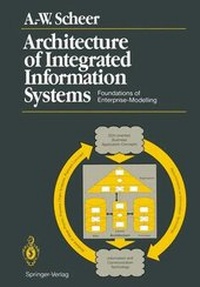
Architecture of Integrated Information Systems
Foundations of Enterprise Modelling
Published on 10. July 1992
Book
Hardback
XIV, 219 pages
978-3-540-55131-7 (ISBN)
Description
The ARIS architecture developed here is described in concrete terms as an information model within the entity-relationship approach. This information model, in turn, serves as the basis for the systematic and rational application of methods in the development of information systems. Furthermore, it provides the basis for storing the enterprise's application-specific data, organization and function models. The ARIS architecture constitutes a framework within which integrated applications can be developed, optimized and converted into EDP-technical implementations. At the same time, it demonstrates how economics can examine and analyze information systems so as to translate their contents into EDP-form.
More details
Language
English
Place of publication
Heidelberg
Germany
Publishing group
Springer Berlin
Target group
College/higher education
Professional and scholarly
Illustrations
160 figures
Dimensions
Height: 250 mm
Weight
565 gr
ISBN-13
978-3-540-55131-7 (9783540551317)
DOI
10.1007/978-3-642-97389-5
Schweitzer Classification
Other editions
New editions

August-Wilhelm Scheer
ARIS - Business Process Frameworks
Book
08/1999
3rd Edition
Springer
€53.49
Shipment within 7-9 days

August-Wilhelm Scheer
ARIS - Business Process Modeling
Book
11/1998
2nd Edition
Springer
€85.59
Article exhausted; check for reprint

August W. Scheer
ARIS - Business Process Frameworks
Book
1998
2nd Edition
Springer
€37.76
Article not available
Additional editions
August-Wilhelm Scheer
Architecture of Integrated Information Systems
Foundations of Enterprise Modelling
E-Book
12/2012
Springer
€53.49
Available for download
August-Wilhelm Scheer
Architecture of Integrated Information Systems
Foundations of Enterprise Modelling
Book
02/2012
Springer
€53.49
Shipment within 7-9 days
Content
A. Conception of the ARIS Architecture for Integrated Information Systems.- A.I The Process Chain Model as Starting Point for Developing the Architecture.- A.II Derivation of the Aris Architecture by Structuring the Process Chain Model.- A.II.1 Concentration on the Transformation of Information.- A.II.2 Creating Views.- A.II.3 Breakdown of the Resource View Using a Phase Model.- A.III Representation of Information Models.- A.IV Comparison of ARIS with other Architectural Concepts.- A.IV.1 IFIP WG 8.1 Architecture.- A.IV.2 CIM-OSA Architecture.- A.IV.3 Further Architectural Approaches in the Literature.- A.IV.4 Architectural Proposals from Computer Suppliers.- A.V Incorporating the Procedural Model for Creating Information Systems.- A.VI Structure of the Remainder of the Book.- A.VI. 1 Organizational Principle.- A.VI.2 Extending the Descriptive Language.- B. Development of the ARIS Information Model (Meta-Information System).- B.I Process Chain Analysis (Recording the Semantic Starting Position).- B.II Modelling the Requirements Definition.- B.II. 1 Requirements Definition of the Function View.- B.II. 1.1 Function Description.- B.II 1.1.1 Function Structure.- B.II. 1.1.2 Operational Sequence.- B.II. 1.1.3 Processing Forms.- B.II. 1.1.4 Decision Models.- B.II. 1.1.5 The Requirements Definition Function Model.- B.II. 1.2 The Procedural Model for Function Modelling (Requirements Definition).- B.II. 1.2.1 Function View of the Procedural Model for Function Modelling.- B.II. 1.2.2 Organization View of the Procedural Model for Function Modelling.- B.II. 1.2.3 Data View of the Procedural Model for Function Modelling.- B.II. 1.2.4 Control View of the Procedural Model for Function Modelling.- B.II.2 Requirements Definition of the Organization View.- B.II.2.1 Organization Description.- B.II.2.1.1 Organizational Structure.- B.II.2.1.2 User Classes.- B.II.2.1.3 The Organization Model.- B.II.2.2 Procedural Model for Organization Modelling.- B.II.2.2.1 Function View.- B.II.2.2.2 Organization View.- B.II.2.2.3 Data View.- B.II.2.2.4 Control View.- B.II.3 Requirements Definition of the Data View.- B.II.3.1 Data Description.- B.II.3.1.1 The Simple ERM.- B.II.3.1.2 The Extended ERM.- B.II.3.2 Procedural Model for Data Modelling.- B.II.3.2.1 Function View.- B.II.3.2.2 Organization View.- B.II.3.2.3 Data View.- B.II.3.2.4 Control View.- B.II.4 Requirements Definition of the Control View.- B.II.4.1 Description of the Control View.- B.II.4.1.1 Linking Functions and Organization.- B.II.4.1.2 Linking Functions and Data.- B.II.4.1.2.1 Event Control.- B.II.4.1.2.2 Data Flow.- B.II.4.1.2.3 Object-Oriented Modelling.- B.II.4.1.3 Linking Organization and Data.- B.II.4.1.4 Linking Functions, Organization and Data.- B.II.4.1.5 The Requirements Definition-Control Model.- B.II.4.2 Procedural Model for the Control Modelling.- B.III Design Specification.- B.III. 1 Design Specification of the Function View.- B.III. 1.1 Module Design.- B.III. 1.2 Mini-Specification.- B.III. 1.3 Output Presentation.- B.III.2 Design Specification of the Organization View.- B.III.2.1 Network Topology.- B.III.2.2 Component Types.- B.III.3 Design Specification of the Data View.- B.III.3.1 Forming Relations.- B.III.3.2 Normalization-Denormalization.- B.III.3.3 Integrity Conditions.- B.III.3.4 Logical Access Paths.- B.III.3.5 Schema for a Database Management System.- B.III.4 Design Specification of the Control View.- B.III.4.1 Linking Module and Organization.- B.III.4.2 Linking Module and Data.- B.III.4.2.1 External Schemata.- B.III.4.2.2 Derivation of Control Structures.- B.III.4.2.3 Database Transactions.- B.III.4.2.4 Trigger Control.- B.III.4.3 Linking Organization and Data.- B.III.4.3.1 Linking User and Data.- B.III.4.3.2 Linking Organizational Units and Data: Distributed Databases.- B.III.4.4 Linking Module, Organization and Data (Distributed Data Processing).- B.IV Design of the Implementation Description.- B.IV.1 Implementation Description of the Function View.- B.IV.2 Implementation Description of the Organization View.- B. IV.3 Implementation Description of the Data View.- B.IV.3.1 Storage.- B.IV.3.2 Storage Assignment.- B.IV.4 Implementation Description of the Control View.- B.V The ARIS Information Model.- References.