

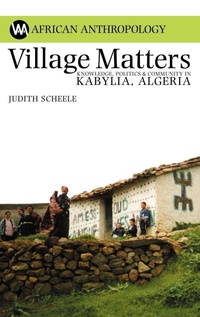
Village Matters
Knowledge, Politics and Community in Kabylia, Algeria
Published on 19. March 2009
Book
Hardback
191 pages
978-1-84701-205-0 (ISBN)
Description
Traces Kabylia's history through French occupation, the Algerian war of independence, and the political turmoil that followed.
Kabylia is a Berber-speaking, densely populated mountainous region east of Algiers, that has played an important part in Algerian pre- and post-independence politics, and continues to be troublesome to central government. But 'Kabylia' is also an ideal, shaped and shared by a variety of intellectual trends both in Algeria and in France.
Kabylia was seen by sociologically minded nineteenth-century French authors as a model of primitive democracy and became central to their debates about good government, the nature of 'race', nationhood, and the social bond. These qualities have by now largely been appropriated by Kabyles themselves, and have become central to Kabyle self-images discussed on numerous websites run by Kabyle emigrants in France as much as by local parties and associations in Kabylia itself.
Central to this image is the Kabyles' attachment to their home villages. But what exactly makes a village a village? And how can this emphasis on communal autonomy be articulated within a modern nation-state? These are the questions this book tries to answer through an in-depth case study of one particular village, analysing the contemporary debates that animate it, and tracing its history through the French conquest and occupation, the Algerian war of independence, and the political turmoil, including the challenge of Islamist politics, that followed independence.
The 'village', as much as Kabylia as a whole, emerges as a place made by its internal contradictions, and that can only be understood with reference to the position it occupies within the various intellectual, political, economic and cultural 'world-systems' of which it is part.
Judith Scheele is a Research Fellow at Magdalen College, Oxford
Kabylia is a Berber-speaking, densely populated mountainous region east of Algiers, that has played an important part in Algerian pre- and post-independence politics, and continues to be troublesome to central government. But 'Kabylia' is also an ideal, shaped and shared by a variety of intellectual trends both in Algeria and in France.
Kabylia was seen by sociologically minded nineteenth-century French authors as a model of primitive democracy and became central to their debates about good government, the nature of 'race', nationhood, and the social bond. These qualities have by now largely been appropriated by Kabyles themselves, and have become central to Kabyle self-images discussed on numerous websites run by Kabyle emigrants in France as much as by local parties and associations in Kabylia itself.
Central to this image is the Kabyles' attachment to their home villages. But what exactly makes a village a village? And how can this emphasis on communal autonomy be articulated within a modern nation-state? These are the questions this book tries to answer through an in-depth case study of one particular village, analysing the contemporary debates that animate it, and tracing its history through the French conquest and occupation, the Algerian war of independence, and the political turmoil, including the challenge of Islamist politics, that followed independence.
The 'village', as much as Kabylia as a whole, emerges as a place made by its internal contradictions, and that can only be understood with reference to the position it occupies within the various intellectual, political, economic and cultural 'world-systems' of which it is part.
Judith Scheele is a Research Fellow at Magdalen College, Oxford
Reviews / Votes
A very fine study [and] a nuanced history and critique of the colonial sources, archival and published, so critical to her principal argument. * INTERNATIONAL JOURNAL OF AFRICAN HISTORICAL STUDIES * An utterly compelling political ethnography of Algeria. [...] Village Matters is social anthropology at its very best, successfully deploying ethnographic and archival methodologies to present a complex picture of a local social world, while questioning fundamental assumptions that have for too long hamstrung the discipline into the mere description of the local. Beyond its contribution to the study of Algeria, Scheele provides a compelling model for understanding the politics of community writ large. * JOURNAL OF THE ROYAL ANTHROPOLOGICAL INSTITUTE * [An] outstanding ethnography. [...] This compelling ethnography is as critical to understanding modern Algeria as Alistair Horne's historical A Savage War of Peace. * CHOICE *More details
Series
Language
English
Place of publication
Oxford
United Kingdom
Target group
College/higher education
Product notice
Cloth over boards
Illustrations
11 b/w, 7 line illus.
Dimensions
Height: 240 mm
Width: 161 mm
Thickness: 15 mm
Weight
458 gr
ISBN-13
978-1-84701-205-0 (9781847012050)
Copyright in bibliographic data and cover images is held by Nielsen Book Services Limited or by the publishers or by their respective licensors: all rights reserved.
Schweitzer Classification
Other editions
Additional editions
E-Book
03/2009
1st Edition
De Gruyter
€48.99
Available for download
Person
Judith Scheele is a research fellow at Magdalen College, Oxford
Content
Introduction
Massinissah's children
The republic of martyrs
Shifting centres
The theft of history
The centres of the world
Speaking in the name of the village
Conclusion
Massinissah's children
The republic of martyrs
Shifting centres
The theft of history
The centres of the world
Speaking in the name of the village
Conclusion