

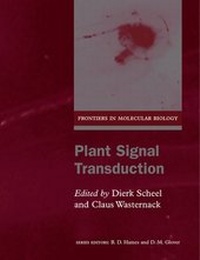
Plant Signal Transduction
Published on 28. March 2002
Book
Paperback/Softback
346 pages
978-0-19-963879-6 (ISBN)
Description
The growth and differentiation of living organisms are continuously adjusted to a multitude of environmental factors, each of which underlies a perpetual variation. The sessile existence of plants further emphasizes the requirement for efficient adaptation and defence mechanisms. The changes in environmental factors may range from moderate to dramatic and can concern many components at the same time. They may be abiotic or biotic in nature and range from essential to toxic in their effects. Among the numerous abiotic factors are nutrients, light, oxygen, water, temperature, gravity, wind, touch and chemicals. Biotic factors are represented by other organisms involved in symbiotic, pathogenic or herbivorous interactions with plants. All of these environmental factors are independently and specifically recognized by plants.
Perception and overall response are linked by signal transduction pathways at cellular, systemic and interorganismic levels. In order to guarantee proper adaptation to the environment, signals generated following perception of a multitude of environmental factors need to be integrated and evaluated according to their importance. Cross-talk between different signaling pathways within such networks appears to be the basis for the evaluation of the importance of incoming signals. Knowledge of these complex processes allows a better understanding of the molecular mechanisms underlying adaptation. Modulation of distinct signaling elements can generate plants with improved stress resistance.
This book represents a comprehensive summary of the enormous amount of information that is now available on signal transduction processes involved in the communication of plants with abiotic and biotic elements of their environment.
Perception and overall response are linked by signal transduction pathways at cellular, systemic and interorganismic levels. In order to guarantee proper adaptation to the environment, signals generated following perception of a multitude of environmental factors need to be integrated and evaluated according to their importance. Cross-talk between different signaling pathways within such networks appears to be the basis for the evaluation of the importance of incoming signals. Knowledge of these complex processes allows a better understanding of the molecular mechanisms underlying adaptation. Modulation of distinct signaling elements can generate plants with improved stress resistance.
This book represents a comprehensive summary of the enormous amount of information that is now available on signal transduction processes involved in the communication of plants with abiotic and biotic elements of their environment.
Reviews / Votes
... provides a broad spectrum of information and is a valuable reference source ... can be recommended for a readership from senior undergraduates to scientists working on or interested in plant signal transduction. * Journal of Plant Physiology *More details
Series
Language
English
Place of publication
Oxford
United Kingdom
Target group
Professional and scholarly
Illustrations
numerous line figures
Dimensions
Height: 245 mm
Width: 189 mm
Thickness: 21 mm
Weight
810 gr
ISBN-13
978-0-19-963879-6 (9780199638796)
Copyright in bibliographic data and cover images is held by Nielsen Book Services Limited or by the publishers or by their respective licensors: all rights reserved.
Schweitzer Classification
Other editions
Additional editions
Dierk Scheel | Claus Wasternack
Plant Signal Transduction
Book
03/2002
Oxford University Press
€229.41
Article exhausted; check different version
Persons
Content
1. Signal transduction in plants: cross talk with the environment ; 2. Light perception and signal transduction ; 3. Wound- and mechanical signalling ; 4. The role of active oxygen species in plant signal transduction ; 5. Heat stress-induced signalling ; 6. Molecular mechanisms of signal transduction in cold acclimation ; 7. Dehydration stress signal transduction ; 8. Salt stress signal transduction in plants ; 9. Recognition and defense signalling in plant/bacterial and fungal interactions ; 10. Signalling in plant-virus interactions ; 11. LCO signalling in the interaction between rhizobia and legumes ; 12. Rhizospheric signals and early molecular events in the ectomycorrhizal symbiosis ; 13. Signalling in plant-insect interactions: signal transduction in direct and indirect plant defence