

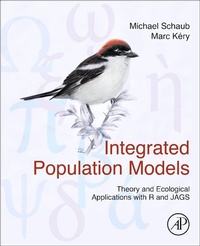
Integrated Population Models
Theory and Ecological Applications with R and JAGS
Published on 23. November 2021
Book
Paperback/Softback
638 pages
978-0-12-820564-8 (ISBN)
Description
Integrated Population Models: Theory and Ecological Applications with R and JAGS is the first book on integrated population models, which constitute a powerful framework for combining multiple data sets from the population and the individual levels to estimate demographic parameters, and population size and trends. These models identify drivers of population dynamics and forecast the composition and trajectory of a population.
Written by two population ecologists with expertise on integrated population modeling, this book provides a comprehensive synthesis of the relevant theory of integrated population models with an extensive overview of?practical applications, using Bayesian methods by means of case studies. The book contains fully-documented, complete code for fitting all models in the free software, R and JAGS. It also includes all required code for pre- and post-model-fitting analysis.
Integrated Population Models is an invaluable reference for researchers and practitioners involved in population analysis, and for graduate-level students in ecology, conservation biology, wildlife management, and related fields.?The text is ideal for self-study and advanced graduate-level courses.
Written by two population ecologists with expertise on integrated population modeling, this book provides a comprehensive synthesis of the relevant theory of integrated population models with an extensive overview of?practical applications, using Bayesian methods by means of case studies. The book contains fully-documented, complete code for fitting all models in the free software, R and JAGS. It also includes all required code for pre- and post-model-fitting analysis.
Integrated Population Models is an invaluable reference for researchers and practitioners involved in population analysis, and for graduate-level students in ecology, conservation biology, wildlife management, and related fields.?The text is ideal for self-study and advanced graduate-level courses.
Reviews / Votes
"This book represents the fourth in a series involving one or both of these authors. Their volumes all provide the theory underpinning the models, a heuristic description of the models, and R code for implementing them. Their books and accompanying workshops are fueling a rapid shift in the approach to analyses of ecological data. This newest work will move population ecology fully into the Bayesian paradigm. Every important advance in methodology is, however, a double-edged sword; with the increased analytical power comes an increase in the number and magnitude of potential errors. Integrated population models are no exception. Schaub and Kery address many of these potential problems but they could have been a bit stronger in emphasizing the importance of such problems. Despite this minor criticism, this is an important volume that will revolutionize the practice of population ecology. Every population ecologist should own a copy." --The Quarterly Review of BiologyMore details
Language
English
Place of publication
San Diego
United States
Publishing group
Elsevier Science Publishing Co Inc
Target group
Professional and scholarly
<i>Integrated Population Models</i> is an invaluable reference for researchers and practitioners involved in population analysis, and for graduate-level students in ecology, conservation biology, wildlife management, and related fields. The text is ideal for self-study and advanced graduate-level courses.
Illustrations
Approx. 225 illustrations (25 in full color)
Dimensions
Height: 276 mm
Width: 216 mm
ISBN-13
978-0-12-820564-8 (9780128205648)
Copyright in bibliographic data and cover images is held by Nielsen Book Services Limited or by the publishers or by their respective licensors: all rights reserved.
Schweitzer Classification
Other editions
Additional editions
Michael Schaub | Marc Kery
Integrated Population Models
Theory and Ecological Applications with R and JAGS
Book
11/2021
Academic Press
€121.50
Shipment within 15-20 days
Michael Schaub | Marc Kéry
Integrated Population Models
Theory and Ecological Applications with R and JAGS
E-Book
11/2021
Academic Press
€109.00
Available for download
Persons
Michael Schaub is the Head of the Ecology Department at the Swiss Ornithological Institute and a courtesy Professor at the University of Bern. His research interests include population dynamics, capture-recapture models, integrated population models, and migratory birds. He has coauthored approximately 130 peer-reviewed journal publications and the book Bayesian Population Analysis using WinBUGS. Dr. Marc works as a senior scientist at the Swiss Ornithological Institute, Seerose 1, 6204 Sempach, Switzerland. This is a non-profit NGO with about 160 employees dedicated primarily to bird research, monitoring, and conservation. Marc was trained as a plant population ecologist at the Swiss Universities of Basel and Zuerich. After a 2-year postdoc at the (then) USGS Patuxent Wildlife Center in Laurel, MD. During the last 20 years he has worked at the interface between population ecology, biodiversity monitoring, wildlife management, and statistics. He has published more than 100 peer-reviewed journal articles and five textbooks on applied statistical modeling. He has also been very active in teaching fellow biologists and wildlife managers the concepts and tools of modern statistical analysis in their fields in workshops all over the world, something which goes together with his books, which target the same audiences.
Content
1. Introduction
Part I: Theory of Integrated Population Models2. Basics of Bayesian Modeling3. Introduction to Stage-Structured Population Models4. Components of Integrated Population Models5. Introduction to Integrated Population Models6. Benefits of Integrated Population Modeling7. Assessment of Integrated Population Models8. Integrated Population Models with Density-Dependence9. Retrospective Population Analyses10. Population Viability Analyses
Part II: Integrated Population Models in Practice11. Woodchat Shrike12. Peregrine Falcon13. Greater Horseshoe Bat14. Hoopoe15. Black Grouse16. Barn Swallow17. Elk18. Cormorant19. Grey Catbird20. Kestral21. Black Bear22. Conclusions
Part I: Theory of Integrated Population Models2. Basics of Bayesian Modeling3. Introduction to Stage-Structured Population Models4. Components of Integrated Population Models5. Introduction to Integrated Population Models6. Benefits of Integrated Population Modeling7. Assessment of Integrated Population Models8. Integrated Population Models with Density-Dependence9. Retrospective Population Analyses10. Population Viability Analyses
Part II: Integrated Population Models in Practice11. Woodchat Shrike12. Peregrine Falcon13. Greater Horseshoe Bat14. Hoopoe15. Black Grouse16. Barn Swallow17. Elk18. Cormorant19. Grey Catbird20. Kestral21. Black Bear22. Conclusions