

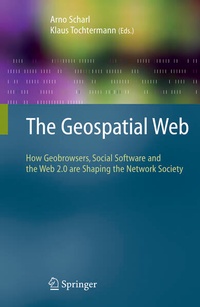
The Geospatial Web
How Geobrowsers, Social Software and the Web 2.0 are Shaping the Network Society
Published on 22. October 2010
Book
Paperback/Softback
XIV, 296 pages
978-1-84996-656-6 (ISBN)
Description
The most important attribute of geospatial platforms is their unique potential to aggregate a multitude of public and private geographic data sets, providing access to data from government agencies, industry and the general public. NASA and other organizations have a wealth of planetary science data - representing the output from thousands of satellites in earth-orbit, and from dozens of costly missions to other planets. Benefits derived from both the data and visual interfaces to access the data represent a significant return on investment for the public. Integrating geospatial data with semantic and collaborative Web technology multiplies the public benefits and represents the main focus of this book. The user interfaces of geobrowsers are designed for the layperson, giving conv- ient access to all kinds of geographically referenced information. Geobrowsers hide the technical details related to finding, accessing and retrieving such information. The daunting challenge of the Geospatial Web is to seamlessly integrate and display vastly different information modes. Nowadays, it is not enough to simply display a map of some region; additional dynamic information modes need to be displayed and put into context - from weather sensor readings and live aerial video feeds to daily news updates, photo collections and video archives.
Reviews / Votes
From the reviews:
"The Geospatial Web is an edited volume of 25 chapters, which attempts to bring together the academic research on Geospatial web technologies and provide an up-to-date review of this fast moving discipline. . would suit postgraduate students who have the knowledge to be selective: picking out chapters of particular relevance." (Ed. Parsons, GIS Professional, Issue 17, 2007)
More details
Series
Edition
1st ed. Softcover of orig. ed. 2007
Language
English
Place of publication
London
United Kingdom
Target group
Professional and scholarly
Research
Illustrations
93 s/w Abbildungen
XIV, 296 p. 93 illus.
Dimensions
Height: 235 mm
Width: 155 mm
Thickness: 17 mm
Weight
476 gr
ISBN-13
978-1-84996-656-6 (9781849966566)
DOI
10.1007/978-1-84628-827-2
Schweitzer Classification
Other editions
Additional editions
Arno Scharl | Klaus Tochtermann
The Geospatial Web
How Geobrowsers, Social Software and the Web 2.0 are Shaping the Network Society
E-Book
02/2009
1st Edition
Springer
€96.29
Available for download
Arno Scharl | Klaus Tochtermann
The Geospatial Web
How Geobrowsers, Social Software and the Web 2.0 are Shaping the Network Society
Book
06/2007
Springer
€106.99
Shipment within 15-20 days
Content
Foundations Of The Geospatial Web.- Towards the Geospatial Web: Media Platforms for Managing Geotagged Knowledge Repositories.- Infrastructure for the Geospatial Web.- Imaging on the Geospatial Web Using JPEG 2000.- What's So Special about Spatial?.- Navigating The Geospatial Web.- Conceptual Search: Incorporating Geospatial Data into Semantic Queries.- Location-based Web Search.- Ubiquitous Browsing of the World.- Spatiotemporal-Thematic Data Processing for the Semantic Web.- Building The Geospatial Web.- A Semantic Approach for Geospatial Information Extraction from Unstructured Documents.- Enhancing RSS Feeds with Extracted Geospatial Information for Further Processing and Visualization.- A Supervised Machine Learning Approach to Toponym Disambiguation.- Geospatial Communities.- Geospatial Information Integration for Science Activity Planning at the Mars Desert Research Station.- Inferences of Social and Spatial Communities over the World Wide Web.- Participating in the Geospatial Web: Collaborative Mapping, Social Networks and Participatory GIS.- Sharing, Discovering and Browsing Geotagged Pictures on the World Wide Web.- Supporting Geo-Semantic Web Communities with the DBin Platform: Use Cases and Perspectives.- Environmental Applications.- A Geospatial Web Platform for Natural Hazard Exposure Assessment in the Insurance Sector.- Development, Implementation and Application of the WebGIS MossMet.- European Air Quality Mapping through Interpolation with Application to Exposure and Impact Assessment.- to Ubiquitous Cartography and Dynamic Geovisualization with Implications for Disaster and Crisis Management.- Fire Alerts for the Geospatial Web.- Geospatial Web Services.- Geospatial Web Services: The Evolution of Geospatial Data Infrastructure.- SWING - A SemanticFramework for Geospatial Services.- Similarity-based Retrieval for Geospatial Semantic Web Services Specified Using the Web Service Modeling Language (WSML-Core).- Geospatial Data Integration with Semantic Web Services: The eMerges Approach.