

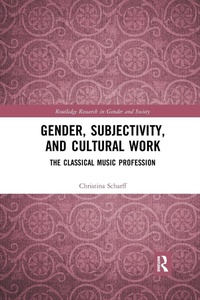
Gender, Subjectivity, and Cultural Work
The Classical Music Profession
1st Edition
Published on 21. May 2019
Book
Paperback/Softback
224 pages
978-0-367-35126-7 (ISBN)
Description
What is it like to work as a classical musician today? How can we explain ongoing gender, racial, and class inequalities in the classical music profession? What happens when musicians become entrepreneurial and think of themselves as a product that needs to be sold and marketed?
Gender, Subjectivity, and Cultural Work explores these and other questions by drawing on innovative, empirical research on the working lives of classical musicians in Germany and the UK. Indeed, Scharff examines a range of timely issues such as the gender, racial, and class inequalities that characterise the cultural and creative industries; the ways in which entrepreneurialism - as an ethos to work on and improve the self - is lived out; and the subjective experiences of precarious work in so-called 'creative cities'. Thus, this book not only adds to our understanding of the working lives of artists and creatives, but also makes broader contributions by exploring how precarity, neoliberalism, and inequalities shape subjective experiences.
Contributing to a range of contemporary debates around cultural work, Gender, Subjectivity, and Cultural Work will be of interest to scholars and students in the fields of Sociology, Gender and Cultural Studies.
Gender, Subjectivity, and Cultural Work explores these and other questions by drawing on innovative, empirical research on the working lives of classical musicians in Germany and the UK. Indeed, Scharff examines a range of timely issues such as the gender, racial, and class inequalities that characterise the cultural and creative industries; the ways in which entrepreneurialism - as an ethos to work on and improve the self - is lived out; and the subjective experiences of precarious work in so-called 'creative cities'. Thus, this book not only adds to our understanding of the working lives of artists and creatives, but also makes broader contributions by exploring how precarity, neoliberalism, and inequalities shape subjective experiences.
Contributing to a range of contemporary debates around cultural work, Gender, Subjectivity, and Cultural Work will be of interest to scholars and students in the fields of Sociology, Gender and Cultural Studies.
Reviews / Votes
This is a beautifully written and compelling account of what it is like to work in the classical music profession. Written with admirable clarity and great insight, the book makes a major contribution to our understanding of gendered subjectivity in the workplace, and also to the growing field of studies of creative labour. A magnificent book that deserves to become essential reading.Rosalind Gill, Professor of Cultural and Social Analysis, City University of London, UK
This is a dazzling and important book. Meticulously researched, Scharff documents the ways in which female classical musicians experience their own professional identities and how they become 'entrepreneurial subjects'. Scharff plays close attention to the texture of inequities in this milieu, and to how competition takes specifically gendered forms. The book is a major contribution to creative economy studies, to sociology, social psychology and gender studies.
Angela McRobbie, Professor of Communications, Goldsmiths University of London, UK
Christina Scharff's book is a superbly thoughtful and insightful feminist study of women musicians in two contrasting cities, and it is also a major contribution to studies of creative labour. It shows how cultural workers are required to be entrepreneurs - and skilfully reveals how this contributes to workplace inequalities.
David Hesmondhalgh, Professor of Media, Music and Culture, University of Leeds, UK
More details
Series
Language
English
Place of publication
London
United Kingdom
Publishing group
Taylor & Francis Ltd
Target group
College/higher education
Product notice
Paperback (trade)
Unsewn / adhesive bound
Illustrations
10 s/w Abbildungen, 10 s/w Zeichnungen, 4 s/w Tabellen
4 Tables, black and white; 10 Line drawings, black and white; 10 Illustrations, black and white
Dimensions
Height: 233 mm
Width: 151 mm
Thickness: 14 mm
Weight
358 gr
ISBN-13
978-0-367-35126-7 (9780367351267)
Copyright in bibliographic data and cover images is held by Nielsen Book Services Limited or by the publishers or by their respective licensors: all rights reserved.
Schweitzer Classification
Other editions
Additional editions
E-Book
09/2017
Routledge
€64.49
Available for download
E-Book
09/2017
Routledge
€64.49
Available for download
Book
09/2017
1st Edition
Routledge
€193.50
Shipment within 10-20 days
Person
Christina Scharff is Senior Lecturer in Culture, Media and Creative Industries at King's College London
Content
List of Tables
Acknowledgments
Introduction
1 Setting the stage: the cultural and creative industries, entrepreneurialism, and the classical music profession
2 Documenting and explaining inequalities in the classical music profession
3 The silence that is not a rest: negotiating hierarchies of class, race, and gender
4 Entrepreneurialism at work: mapping the contours of entrepreneurial subjectivity
5 "Difficult, fickle, tumultuous" and yet "the best job in the world": analysing subjective experiences of precarious work
6 Structures of feeling in two creative cities: London and Berlin
Conclusion: key contributions, directions for further research, and recommendations
Acknowledgments
Introduction
1 Setting the stage: the cultural and creative industries, entrepreneurialism, and the classical music profession
2 Documenting and explaining inequalities in the classical music profession
3 The silence that is not a rest: negotiating hierarchies of class, race, and gender
4 Entrepreneurialism at work: mapping the contours of entrepreneurial subjectivity
5 "Difficult, fickle, tumultuous" and yet "the best job in the world": analysing subjective experiences of precarious work
6 Structures of feeling in two creative cities: London and Berlin
Conclusion: key contributions, directions for further research, and recommendations