

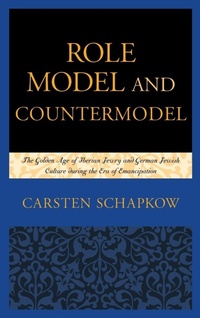
Role Model and Countermodel
The Golden Age of Iberian Jewry and German Jewish Culture during the Era of Emancipation
Published on 9. December 2015
Book
Hardback
322 pages
978-1-4985-0802-5 (ISBN)
Description
This book explores the "Golden Age" of Sephardic Jewry on the Iberian Peninsula and its perception in German Jewish culture during the era of emancipation. For Jews living in Germany, the history of Sephardic Jewry developed into a historical example with its distinctive valence and signature against the pressure to assimilate and the emergence of anti-Semitism in Germany. It provided, moreover, a forum to engage in internal dialogue amongst Jews and external dialogue with German majority society about challenging questions of religious, political, and national identity. In this respect, the perception of prominent Sephardic Jews as intercultural mediators was key to emphasizing the skills and values Jews had to offer to civilizations in the past. German Jews invoked this past significance in their case for a Jewish role in present and future societies, especially in Germany.
Reviews / Votes
The study touches on several interesting aspects.... The German Jewish discovery of Jewish life in medieval Spain provides an intriguing perspective on a Jewish community in transition. * AJS Review * In this fluent, accessible and compelling study, Carsten Schapkow provides the first detailed survey of how German Jews, from Mendelssohn to Graetz, looked back to the Jews of medieval al-Andalus, and made use of this Iberian model in their collective memory and in debates over political emancipation and cultural pluralism. The 'Sephardic mystique', he shows, was considerably more complex and contentious than most historians have realized. Drawing on an extremely wide range of sources-political, historiographical, philosophical, and fictional-Schapkow's study elegantly weaves together these various strands of German Jewish cultural memory in the age of emancipation. -- Adam Sutcliffe, King's College London Carsten Schapkow's Role Model and Countermodel is the first encompassing monograph on the Ashkenazi reception of Sephardic History in eighteenth- and nineteenth-century Germany. The book is not only an important contribution to a better understanding of German Jewry, but also a vivid example of the much-too-often-neglected study of entanglements between Sephardic and Ashkenazi histories. -- Sina Rauschenbach, University of Potsdam While there have been a number of important articles in recent years on the nineteenth-century German Jewish fascination with the history and culture of their coreligionists in medieval Iberia, there has not been till now a detailed monographic analysis of the phenomenon. Carsten Schapkow has provided a wide-ranging, in-depth, and sophisticated survey of the creation and propagation of the Golden Age of Spain myth by the founding fathers of modern Judaic Studies (Wissenschaft des Judentums) in Germany, the myth's adoption by popular writers, and its growth into an idealized model for how Jews might successfully assimilate into German society while still maintaining a distinctive Jewish identity. -- Norman A. Stillman, University of OklahomaMore details
Language
English
Place of publication
United States
Publishing group
Bloomsbury Publishing Plc
Target group
Professional and scholarly
Dimensions
Height: 235 mm
Width: 157 mm
Thickness: 24 mm
Weight
675 gr
ISBN-13
978-1-4985-0802-5 (9781498508025)
Copyright in bibliographic data and cover images is held by Nielsen Book Services Limited or by the publishers or by their respective licensors: all rights reserved.
Schweitzer Classification
Other editions
Additional editions
Carsten Schapkow
Role Model and Countermodel
The Golden Age of Iberian Jewry and German Jewish Culture During the Era of Emancipation
E-Book
12/2015
1st Edition
Lexington Books
€124.99
Available for download
Carsten Schapkow
Role Model and Countermodel
The Golden Age of Iberian Jewry and German Jewish Culture During the Era of Emancipation
E-Book
12/2015
1st Edition
Lexington Books
€124.99
Available for download
Persons
Carsten Schapkow is associate professor of history and Judaic studies at the University of Oklahoma.
Content
Chapter 1:Iberian-Sephardic Culture as Intercultural System of Reference: Between Appropriation and Disassociation
Chapter 2:The Significance of Iberian-Sephardic Culture for the Haskalah
Chapter 3: The Origins of the Science of Judaism: Iberian-Sephardic Jews as Proponents of a European Cultural Tradition
Chapter 4 Jewish Historiography and Jewish History in Spain as a Counter-Model
Chapter 5:Adaptations of the Iberian Role and Counter Model
Conclusion
Chapter 2:The Significance of Iberian-Sephardic Culture for the Haskalah
Chapter 3: The Origins of the Science of Judaism: Iberian-Sephardic Jews as Proponents of a European Cultural Tradition
Chapter 4 Jewish Historiography and Jewish History in Spain as a Counter-Model
Chapter 5:Adaptations of the Iberian Role and Counter Model
Conclusion