

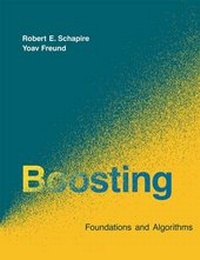
Boosting
Foundations and Algorithms
Published on 25. May 2012
Book
Hardback
544 pages
978-0-262-01718-3 (ISBN)
Description
An accessible introduction and essential reference for an approach to machine learning that creates highly accurate prediction rules by combining many weak and inaccurate ones.
Boosting is an approach to machine learning based on the idea of creating a highly accurate predictor by combining many weak and inaccurate "rules of thumb." A remarkably rich theory has evolved around boosting, with connections to a range of topics, including statistics, game theory, convex optimization, and information geometry. Boosting algorithms have also enjoyed practical success in such fields as biology, vision, and speech processing. At various times in its history, boosting has been perceived as mysterious, controversial, even paradoxical.
This book, written by the inventors of the method, brings together, organizes, simplifies, and substantially extends two decades of research on boosting, presenting both theory and applications in a way that is accessible to readers from diverse backgrounds while also providing an authoritative reference for advanced researchers. With its introductory treatment of all material and its inclusion of exercises in every chapter, the book is appropriate for course use as well.
The book begins with a general introduction to machine learning algorithms and their analysis; then explores the core theory of boosting, especially its ability to generalize; examines some of the myriad other theoretical viewpoints that help to explain and understand boosting; provides practical extensions of boosting for more complex learning problems; and finally presents a number of advanced theoretical topics. Numerous applications and practical illustrations are offered throughout.
Boosting is an approach to machine learning based on the idea of creating a highly accurate predictor by combining many weak and inaccurate "rules of thumb." A remarkably rich theory has evolved around boosting, with connections to a range of topics, including statistics, game theory, convex optimization, and information geometry. Boosting algorithms have also enjoyed practical success in such fields as biology, vision, and speech processing. At various times in its history, boosting has been perceived as mysterious, controversial, even paradoxical.
This book, written by the inventors of the method, brings together, organizes, simplifies, and substantially extends two decades of research on boosting, presenting both theory and applications in a way that is accessible to readers from diverse backgrounds while also providing an authoritative reference for advanced researchers. With its introductory treatment of all material and its inclusion of exercises in every chapter, the book is appropriate for course use as well.
The book begins with a general introduction to machine learning algorithms and their analysis; then explores the core theory of boosting, especially its ability to generalize; examines some of the myriad other theoretical viewpoints that help to explain and understand boosting; provides practical extensions of boosting for more complex learning problems; and finally presents a number of advanced theoretical topics. Numerous applications and practical illustrations are offered throughout.
More details
Series
Language
English
Place of publication
Cambridge, Mass.
United States
Publishing group
MIT Press Ltd
Target group
Professional and scholarly
Interest Age: From 18 years
Illustrations
77 s/w Abbildungen
77 b&w illus.
Dimensions
Height: 229 mm
Width: 178 mm
Thickness: 24 mm
Weight
975 gr
ISBN-13
978-0-262-01718-3 (9780262017183)
Copyright in bibliographic data and cover images is held by Nielsen Book Services Limited or by the publishers or by their respective licensors: all rights reserved.
Schweitzer Classification
Other editions
Additional editions
Book
01/2014
MIT Press
€45.80
Article exhausted; check different version
Persons
Robert E. Schapire is Professor of Computer Science at Princeton University. Yoav Freund is Professor of Computer Science at the University of California, San Diego. For their work on boosting, Freund and Schapire received both the Gödel Prize in 2003 and the Kanellakis Theory and Practice Award in 2004.