

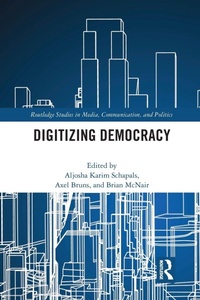
Digitizing Democracy
1st Edition
Published on 30. June 2020
Book
Paperback/Softback
230 pages
978-0-367-58446-7 (ISBN)
Description
What are the key challenges facing our increasingly digitized democracy, and how might we as citizens contribute to resolving them? This book explores these questions, adopting a multi-disciplinary approach that combines work from media studies, journalism studies, and political science scholars, and draws on trends in countries including Australia, the United States, the United Kingdom, Egypt, and Indonesia. The book is divided into four main themes: (1) the impact of digital communication on politics and government; (2) the future of news and journalism in the network society; (3) the potential of digital media to enhance civic engagement and social inclusion; and (4) visions for the future of digital democracy.
More details
Series
Language
English
Place of publication
London
United Kingdom
Publishing group
Taylor & Francis Ltd
Target group
College/higher education
Postgraduate and Undergraduate
Dimensions
Height: 229 mm
Width: 152 mm
Thickness: 13 mm
Weight
357 gr
ISBN-13
978-0-367-58446-7 (9780367584467)
Copyright in bibliographic data and cover images is held by Nielsen Book Services Limited or by the publishers or by their respective licensors: all rights reserved.
Schweitzer Classification
Other editions
Additional editions
Aljosha Karim Schapals | Axel Bruns | Brian McNair
Digitizing Democracy
E-Book
10/2018
Routledge
€59.49
Available for download
Aljosha Karim Schapals | Axel Bruns | Brian McNair
Digitizing Democracy
E-Book
10/2018
1st Edition
Routledge
€59.49
Available for download
Aljosha Karim Schapals | Axel Bruns | Brian McNair
Digitizing Democracy
Book
10/2018
1st Edition
Routledge
€206.40
Shipment within 10-20 days
Persons
Aljosha Karim Schapals is a Lecturer in Journalism and Political Communication at the Queensland University of Technology in Brisbane, Australia, and a Research Associate in the "Journalism beyond the Crisis" project funded by the Australian Research Council.
Axel Bruns is a Professor in the Digital Media Research Centre at Queensland University of Technology, Australia. His latest book is Gatewatching and News Curation: Journalism, Social Media, and the Public Sphere.
Brian McNair is the author of many books and essays on journalism, including Fake News (Routledge, 2018), Introduction to Political Communication (6th edition, Routledge, 2017), and Communication and Political Crisis (Peter Lang, 2016).
Axel Bruns is a Professor in the Digital Media Research Centre at Queensland University of Technology, Australia. His latest book is Gatewatching and News Curation: Journalism, Social Media, and the Public Sphere.
Brian McNair is the author of many books and essays on journalism, including Fake News (Routledge, 2018), Introduction to Political Communication (6th edition, Routledge, 2017), and Communication and Political Crisis (Peter Lang, 2016).
Content
Part I: Politics and Government
1. Fake News and Democratic Culture
(Brian McNair)
2. Mapping pressures on the 'sensible centre'/consensual model of liberal democracy (Eric Louw)
3. Surround-sound elections: campaigning in a fast-evolving digital media environment
(Edwina Throsby)
4. From 'Crush the Saboteurs' to 'Coalition of Crackpots': The role of the partisan 'Tory' press and the power of alternative media during Brexit and #GE17
(Aljosha Karim Schapals)
5. Shifting Conceptions of Voice in Citizen-Government Interactions Using Digital Media in Indonesian Local Democracy
(Terry Flew & Rido Panjaitan)
Part II: News and Journalism
6. Journalism as an advocate for social change and public engagement: Reporting environmental crisis in the digital era
(Susan Forde)
7. Mining the depleted 'rivers of gold': Public notices and the sustainability of Australian local news in a digitized democracy
(Kristy Hess)
8. Journalism and democracy in the network society
(Amanda Gearing)
9. "Cloudy with a chance of sh!tstorm": Examining the role of social news outlets in the Hack Live: Is Male Privilege Bullsh!t? social media ritual
(Edward Hurcombe)
Part III: Digital Societies
10. Digital Public Spheres in Australia
(Axel Bruns)
11. Beyond Deficit Discourse: Reframing Debate in Indigenous Education
(Kerry McCallum, Lisa Waller & Tanja Dreher)
12. The role of social media during the 2011 Egyptian Revolution: A real catalyst, or merely a facilitating factor?
(Aljosha Karim Schapals)
13. IndigenousX: unencumbered, connected
(Sandra Phillips, Sandy O'Sullivan, Luke Pearson)
Part IV: New Visions
14. Digital bullets wound traditions of politics and the media
(David Fagan)
15. The Era of Mega-Leaks
(Rodney Tiffen)
16. The Unfinished Robots Revolution: Ten tips for humans
(John Keane)
1. Fake News and Democratic Culture
(Brian McNair)
2. Mapping pressures on the 'sensible centre'/consensual model of liberal democracy (Eric Louw)
3. Surround-sound elections: campaigning in a fast-evolving digital media environment
(Edwina Throsby)
4. From 'Crush the Saboteurs' to 'Coalition of Crackpots': The role of the partisan 'Tory' press and the power of alternative media during Brexit and #GE17
(Aljosha Karim Schapals)
5. Shifting Conceptions of Voice in Citizen-Government Interactions Using Digital Media in Indonesian Local Democracy
(Terry Flew & Rido Panjaitan)
Part II: News and Journalism
6. Journalism as an advocate for social change and public engagement: Reporting environmental crisis in the digital era
(Susan Forde)
7. Mining the depleted 'rivers of gold': Public notices and the sustainability of Australian local news in a digitized democracy
(Kristy Hess)
8. Journalism and democracy in the network society
(Amanda Gearing)
9. "Cloudy with a chance of sh!tstorm": Examining the role of social news outlets in the Hack Live: Is Male Privilege Bullsh!t? social media ritual
(Edward Hurcombe)
Part III: Digital Societies
10. Digital Public Spheres in Australia
(Axel Bruns)
11. Beyond Deficit Discourse: Reframing Debate in Indigenous Education
(Kerry McCallum, Lisa Waller & Tanja Dreher)
12. The role of social media during the 2011 Egyptian Revolution: A real catalyst, or merely a facilitating factor?
(Aljosha Karim Schapals)
13. IndigenousX: unencumbered, connected
(Sandra Phillips, Sandy O'Sullivan, Luke Pearson)
Part IV: New Visions
14. Digital bullets wound traditions of politics and the media
(David Fagan)
15. The Era of Mega-Leaks
(Rodney Tiffen)
16. The Unfinished Robots Revolution: Ten tips for humans
(John Keane)