

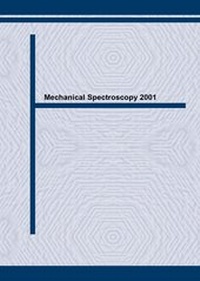
Mechanical Spectroscopy 2001
Published on 13. March 2001
Book
Paperback/Softback
724 pages
978-0-87849-876-5 (ISBN)
Description
Mechanical spectroscopy is a non-destructive technique that is very well suited for studying the dynamics of singularities such as structural defects in solids. It has been successfully applied in solid state physics and materials science for more than fifty years, and the present textbook aims at summarising the state-of-the-art in this field by presenting recent results obtained in Western European laboratories. The contents are divided into nine chapters. Introduction to mechanical spectroscopy (Ch.1) is based on a complete description of the elastic, viscoelastic, and viscoplastic behaviours of solids. The anelastic response is analysed from three different viewpoints: phenomenology, rheology and thermodynamics.
More details
Series
Language
English
Place of publication
Zurich
Switzerland
Target group
College/higher education
Professional and scholarly
Dimensions
Height: 24.5 cm
Width: 17 cm
Thickness: 36 mm
Weight
1800 gr
ISBN-13
978-0-87849-876-5 (9780878498765)
DOI
10.4028/www.scientific.net/MSF.366-368
Schweitzer Classification
Other editions
Additional editions
Trans Tech Publications Ltd | Robert Schaller | Gilbert Fantozzi
Mechanical Spectroscopy 2001
E-Book
03/2001
Trans Tech Publications Ltd
€211.86
Available for download
Robert Schaller | Gilbert Fantozzi | Gerard Gremaud
Mechanical Spectroscopy 2001
Software
03/2001
Trans Tech Publications Ltd
€385.51
Shipment within 10-20 days
Content
1.1 Phenomenology and Definitions
1.2 Mechanical spectroscopy
1.3 Non Linear Dissipative Mechanisms
2. Point Defect Relaxations
3.1 Dislocation: Description and Dynamics
3.2 Dislocation - Lattice Interactions
3.3 Dislocation - Point Defect Interactions
3.4 Dislocation Damping at Medium Temperature
3.5 High Temperature Damping
3.6 Recrystallization
4.1 Grain boundaries: description and dynamics
4.2 Grain Boundary Relaxations in Metals
4.3 Grain Boundary Relaxations in Ceramics
5.1 Thermodynamics of 2nd and 1st Order PhaseTtransformations
5.2 Ferroelectric Transitions
5.3 The Martensitic Transformation
5.4 Transitory Effects
5.5 Precipitation
6.1 Magnetic Domains
6.2 Ferroelectric Domains
7. Non Crystalline Materials
8.1 Thin-layer Materials
8.2 Surface andLlocal Spectroscopy
8.3 Interface Stress Relaxation in Metal Matrix Composites
8.4 Internal Friction in Fibre Reinforced Composites
8.5 Fatigue and Internal Friction
8.6 Damping and Toughness
8.7 High Damping Materials
9.1 Low Frequency Techniques
9.2 Ultrasonics Techniques: PUCOT and ACT
9.3 Scanning Local Acceleration Microscopy: SLAM
9.4 Scanning Acoustic Microscopy: SAM
1.2 Mechanical spectroscopy
1.3 Non Linear Dissipative Mechanisms
2. Point Defect Relaxations
3.1 Dislocation: Description and Dynamics
3.2 Dislocation - Lattice Interactions
3.3 Dislocation - Point Defect Interactions
3.4 Dislocation Damping at Medium Temperature
3.5 High Temperature Damping
3.6 Recrystallization
4.1 Grain boundaries: description and dynamics
4.2 Grain Boundary Relaxations in Metals
4.3 Grain Boundary Relaxations in Ceramics
5.1 Thermodynamics of 2nd and 1st Order PhaseTtransformations
5.2 Ferroelectric Transitions
5.3 The Martensitic Transformation
5.4 Transitory Effects
5.5 Precipitation
6.1 Magnetic Domains
6.2 Ferroelectric Domains
7. Non Crystalline Materials
8.1 Thin-layer Materials
8.2 Surface andLlocal Spectroscopy
8.3 Interface Stress Relaxation in Metal Matrix Composites
8.4 Internal Friction in Fibre Reinforced Composites
8.5 Fatigue and Internal Friction
8.6 Damping and Toughness
8.7 High Damping Materials
9.1 Low Frequency Techniques
9.2 Ultrasonics Techniques: PUCOT and ACT
9.3 Scanning Local Acceleration Microscopy: SLAM
9.4 Scanning Acoustic Microscopy: SAM