

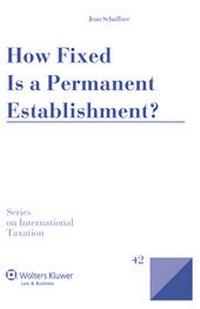
How Fixed Is a Permanent Establishment?
1st Edition
Published on 20. February 2013
Book
Hardback
344 pages
978-90-411-4662-5 (ISBN)
Description
Permanent establishment is the key concept for allocating taxation rights in respect of business income, and the question 'Is there a permanent establishment?' is a tax treaty issue that advisers, government officials, and courts perennially confront. Based on a 'fixed link to the ground', the idea has become progressively more difficult to apply until, at this stage, re-evaluation has become a political necessity. If a permanent establishment may exist in the context of e-commerce, the concept of a geographical presence must be redefined. However, the question remains: Is e-commerce a sufficient reason for challenging the well-established permanent establishment nexus? Drawing on case law, administrative practice, and business decisions in numerous jurisdictions, the author discusses the permanent establishment criteria under conditions of e-commerce and the service economy. He shows that the OECD Model Convention and its commentaries already offer the basis for the evolution of the analysis of the concept, and that the preservation of permanent establishment protects and maintains the level playing field between capital importing and capital exporting economies. He examines in depth such elements as the following:;the prevalence of commercial coherence over geographic coherence; the role of value-added tax; services permanent establishment; relevant definitions of 'activity' and 'personnel'; multiple permanent establishments; supervision activity and sub-contracting; the differences between civil law and common law concepts of representation; particular treatment of the insurance sector; the 'force of attraction' concept; and specific exceptions (e.g., transportation, artists and sportsmen, rental income, agricultural activities, pipelines). Taking into account important distinctions between two model conventions (OECD and UN), as well as pertinent EU directives and the impact of EU law, the author proposes minor amendments to the OECD Model that adapt it to economic reality and current trends in jurisprudence and that can be implemented immediately. An appendix includes Article 5 and its commentaries as they have evolved since 1963, with the successive addenda and deletions. The author's 20-plus years of experience as a tax lawyer lend the presentation a thoroughly practical aspect. The work addresses in more detail than any other publication the topic of profit allocation to a permanent establishment in the e-commerce world, an issue which is evolving rapidly in the current economic environment. Tax advisors, lawyers, and interested academics and policymakers will benefit from the book's clear analysis of the conditions under which a permanent establishment not only should be preserved, but also how it is likely to be adapted in the future.
More details
Other editions
Additional editions
Jean Schaffner
How Fixed Is a Permanent Establishment?
E-Book
02/2013
Kluwer Law International
€206.99
Available for download
Jean Schaffner
How Fixed Is a Permanent Establishment?
E-Book
02/2013
Kluwer Law International
€206.99
Available for download
Content
Introduction. 1. The Roots of International Tax Law and the Permanent Establishment Concept. 2. Historic Evolution of the Permanent Establishment Concept. 3. Recent Developments of the Concept of Permanent Establishment. 4. The Geographical Location and the Basic Definition: The Physical Permanent Establishment. 5. Construction Permanent Establishments. 6. Preparatory or Auxiliary Activities. 7. Agency Permanent Establishment. 8. Conclusion on the Territorial Location. 9. Conclusion. Appendix: Proposed Changes to the Commentaries of Article 5. Bibliography. Discussion papers. Case law and rulings.