

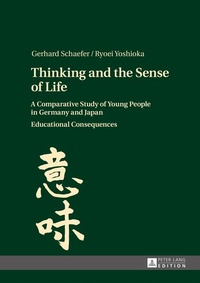
Thinking and the Sense of Life
A Comparative Study of Young People in Germany and Japan- Educational Consequences
Published on 8. October 2014
Book
Hardback
120 pages
978-3-631-65186-5 (ISBN)
Description
Do cognitive/metacognitive abilities favour recognition of sense in life or not? Based on a sample of more than one thousand secondary schools students in Japan and Germany, the correlation between intelligence and perception of sense in life has been empirically examined. The study draws the conclusion that there is no clear correlation between cognition and sense. Finding sense in life seems to be independent from the level of thinking and to be independent as well from particular areas of commitment (e.g. science, technology, art and religion). The main factor discovered so far is a cultural/national one: The majority of Japanese students approve of the idea of sense in life whereas the majority of German students do not. The book discusses the different historical background of the two peer groups as a possible explanation and draws conclusions with respect to education.
More details
Persons
Gerhard Schaefer, biology educator, is professor emeritus of the University of Hamburg. He was the chairman of the Commission for Biological Education (CBE) of the International Union of Biological Sciences (IUBS) for many years and has been the chair of the Educational Commission of the German Society for the Advancement of Science and Medicine (GDNÄ) since 1997. His main fields of research are concept-formation and attitude-development.
Ryoei Yoshioka is a senior researcher of the National Institute for Educational Policy Research (NIER) of Japan. His main fields of research are science education and database in education.
Content
Contents: Eastern/Western way of thinking - Sense of life - Superordinate/subordinate concept-pairing - Personal areas of devotion - Gender - Science - Technology - Idea of Man - Correlation between intelligence and perception of sense in life.