

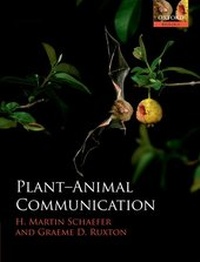
Plant-Animal Communication
Published on 7. April 2011
Book
Hardback
298 pages
978-0-19-956360-9 (ISBN)
Description
Communication is an essential factor underpinning the interactions between species and the structure of their communities. Plant-animal interactions are particularly diverse due to the complex nature of their mutualistic and antagonistic relationships. However the evolution of communication and the underlying mechanisms responsible remain poorly understood.
Plant-Animal Communication is a timely summary of the latest research and ideas on the ecological and evolutionary foundations of communication between plants and animals, including discussions of fundamental concepts such as deception, reliability, and camouflage. It introduces how the sensory world of animals shapes the various modes of communication employed, laying out the basics of vision, scent, acoustic, and gustatory communication. Subsequent chapters discuss how plants communicate in these sensory modes to attract animals to facilitate seed dispersal, pollination, and carnivory, and how they communicate to defend themselves against herbivores. Potential avenues for productive theoretical and empirical research are clearly identified, and suggestions for novel empirical approaches to the study of communication in general are outlined.
Plant-Animal Communication is a timely summary of the latest research and ideas on the ecological and evolutionary foundations of communication between plants and animals, including discussions of fundamental concepts such as deception, reliability, and camouflage. It introduces how the sensory world of animals shapes the various modes of communication employed, laying out the basics of vision, scent, acoustic, and gustatory communication. Subsequent chapters discuss how plants communicate in these sensory modes to attract animals to facilitate seed dispersal, pollination, and carnivory, and how they communicate to defend themselves against herbivores. Potential avenues for productive theoretical and empirical research are clearly identified, and suggestions for novel empirical approaches to the study of communication in general are outlined.
More details
Language
English
Place of publication
Oxford
United Kingdom
Target group
College/higher education
Illustrations
60 illustrations plus an 8 page colour plate section
Dimensions
Height: 248 mm
Width: 196 mm
Thickness: 21 mm
Weight
836 gr
ISBN-13
978-0-19-956360-9 (9780199563609)
Copyright in bibliographic data and cover images is held by Nielsen Book Services Limited or by the publishers or by their respective licensors: all rights reserved.
Schweitzer Classification
Other editions
Additional editions
H. Martin Schaefer | Graeme D. Ruxton
Plant-Animal Communication
E-Book
04/2011
OUP eBook
€51.49
Available for download
H. Martin Schaefer | Graeme D. Ruxton
Plant-Animal Communication
Book
04/2011
Oxford University Press
€69.33
Shipment within 15-20 days
Persons
Martin Schaefer is Associate Professor in Evolutionary Biology and Ecology at the University of Freiburg. His main research interests are the sensory ecology of plant-animal interactions in the three fields covered in this book, seed dispersal, plant defence and carnivory. He uses an integrative approach of combining biochemical analyses with theoretical modelling and experimental work. His work focuses on the behavioural ecology of vertebrates and invertebrates interacting with plants and on the plants themselves. His background in plant physiology and biochemistry will help to describe the proximate mechanisms involved in plant signalling.
Graeme Ruxton has co-authored two previous monographs (Living in Groups, 2002, Oxford University Press; Avoiding attack: the evolutionary ecology of crypsis, warning signals and mimicry, 2004, Oxford University Press). He is Professor of Theoretical Ecology at the University of Glasgow. His main research interests are in sensory ecology and how one species can exploit the senses of another. This research is carried out through mathematical modelling combined with laboratory and field studies. Graeme's background in the sensory ecology of animal-animal predation allow this book to utilise the extensive theoretical developments associate with this field, and translate these into plant-animal interactions.
Graeme Ruxton has co-authored two previous monographs (Living in Groups, 2002, Oxford University Press; Avoiding attack: the evolutionary ecology of crypsis, warning signals and mimicry, 2004, Oxford University Press). He is Professor of Theoretical Ecology at the University of Glasgow. His main research interests are in sensory ecology and how one species can exploit the senses of another. This research is carried out through mathematical modelling combined with laboratory and field studies. Graeme's background in the sensory ecology of animal-animal predation allow this book to utilise the extensive theoretical developments associate with this field, and translate these into plant-animal interactions.
Content
Preface ; 1. Communication and the Evolution of Plant-Animal Interactions ; 2. Animal Sensory Ecology and Plant Biochemistry ; 3. Animals as Seed Dispersers ; 4. Visual Communication in Fleshy Fruits ; 5. Evolutionary Ecology of Non-Visual Fruit Traits ; 6. Flower Signals and Pollination ; 7. The Potential for Leaf Colouration to Communicate to Animals ; 8. Plant Crypsis, Aposematism, and Mimicry ; 9. Chemical Communication by Plants about Herbivores ; 10. Sensory Aspects of Carnivorous Plants ; 11. Final Thoughts ; Glossary ; References ; Index