

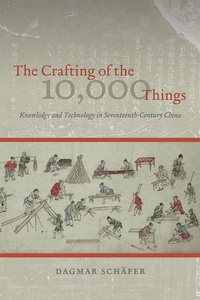
The Crafting of the 10,000 Things - Knowledge and Technology in Seventeenth-Century China
Knowledge and Technology in Seventeenth-Century China
Published on 22. February 2015
Book
Paperback/Softback
352 pages
978-0-226-27280-1 (ISBN)
Description
The last decades of the Ming dynasty, though plagued by chaos and destruction, saw a significant increase in publications that examined advances in knowledge and technology. Among the numerous guides and reference books that appeared during this period was a series of texts by Song Yingxing (1587-1666?), a minor local official living in southern China. His Tiangong kaiwu, the longest and most prominent of these works, documents the extraction and processing of raw materials and the manufacture of goods essential to everyday life, from yeast and wine to paper and ink to boats, carts, and firearms. In The Crafting of the 10,000 Things, Dagmar Schafer probes this fascinating text and the legacy of its author to shed new light on the development of scientific thinking in China, the purpose of technical writing, and its role in and effects on Chinese history.
Reviews / Votes
"The Crafting of the 10,000 Things is a great achievement, which will repay careful reading on the part of historians of Western Europe and other parts of the world, as well as of China." (Metascience)More details
Language
English
Place of publication
Chicago
United States
Publishing group
The University of Chicago Press
Target group
College/higher education
Product notice
Paperback (trade)
Unsewn / adhesive bound
Dimensions
Height: 226 mm
Width: 149 mm
Thickness: 27 mm
Weight
462 gr
ISBN-13
978-0-226-27280-1 (9780226272801)
Copyright in bibliographic data and cover images is held by Nielsen Book Services Limited or by the publishers or by their respective licensors: all rights reserved.
Schweitzer Classification
Person
Dagmar Schafer is head of the independent research group Concepts and Modalities: Practical Knowledge Transmission in China at the Max Planck Institute for the History of Science in Berlin.