

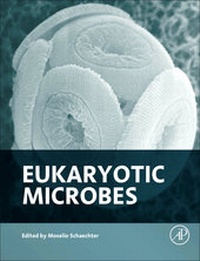
Eukaryotic Microbes
Published on 29. September 2011
Book
Hardback
496 pages
978-0-12-383876-6 (ISBN)
Description
Eukaryotic Microbes presents chapters hand-selected by the editor of the Encyclopedia of Microbiology, updated whenever possible by their original authors to include key developments made since their initial publication. The book provides an overview of the main groups of eukaryotic microbes and presents classic and cutting-edge research on content relating to fungi and protists, including chapters on yeasts, algal blooms, lichens, and intestinal protozoa. This concise and affordable book is an essential reference for students and researchers in microbiology, mycology, immunology, environmental sciences, and biotechnology.
Reviews / Votes
"The book is well illustrated with diagrams, figures and tables, and the chapters are thorough, well-presented and easy to read. The content has been carefully selected from the huge range of topics that are covered under eukaryotic microbiology, and provides an excellent overview. It will be a useful reference work for researchers and students in many areas of eukaryotic microbiology, and of course for all other microbiologists fascinated by these incredible, beautiful and important organisms."--Microbiology TodayMore details
Language
English
Place of publication
San Diego
United States
Publishing group
Elsevier Science Publishing Co Inc
Target group
College/higher education
Professional and scholarly
Students and researchers in microbiology, mycology, immunology, environmental sciences and biotechnology.
Dimensions
Height: 276 mm
Width: 216 mm
Weight
1530 gr
ISBN-13
978-0-12-383876-6 (9780123838766)
Copyright in bibliographic data and cover images is held by Nielsen Book Services Limited or by the publishers or by their respective licensors: all rights reserved.
Schweitzer Classification
Other editions
Additional editions
Person
Dr. Schaechter is a Distinguished Professor, Emeritus at Tufts University, where he served as chairman of the Department of Molecular Biology and Microbiology from 1970 to 1993. He has worked on bacterial growth physiology and the relationship of the chromosome and the bacterial cell membrane. He has authored ten treatises and textbooks, most in collaboration with others, plus a book for the general public, In the Company of Mushrooms. He has served as President of the American Society for Microbiology. Currently, he is Adjunct Professor Emeritus, Biology Department, at San Diego State University and Visiting Scholar at the University of California, San Diego.
Content
PREFACE
I. FUNGI
Yeasts
Aspergillus: A Multifaceted Genus
Clavicipitaceae: Free-Living and Saprotrophs to Plant Endophytes
Microsporidia: a model for minimal parasite-host interactions
Mycorrhizae
Endophytic Microbes
Lichens
Plant Pathogens: Newly Emerging Diseases
Fungal and Protist Plant Pathogens
Entomogenous fungi
Fungal Infections, Systemic
Fungal Infections, Cutaneous
II. PROTISTS
Amitochondriate Protists (Diplomonads, Parabasalids, Oxymonads)
Amoebas (Lobose)
Ciliates
Secretive ciliates and putative asexuality in microbial eukaryotes
Coccolithophores
Diatoms: The Grass Menagerie
Dinoflagellates
Dyctiostelium
Foraminifera
Euglenozoa
Protozoan, Intestinal
Leishmania
Oomycetes (Water Mold)
Picoeukaryotes
Stramenopiles
Toxoplasmosis
Trypanosomes
Sleeping Sickness
Secondary endosymbiosis
Algal blooms
Food Webs, Microbial
I. FUNGI
Yeasts
Aspergillus: A Multifaceted Genus
Clavicipitaceae: Free-Living and Saprotrophs to Plant Endophytes
Microsporidia: a model for minimal parasite-host interactions
Mycorrhizae
Endophytic Microbes
Lichens
Plant Pathogens: Newly Emerging Diseases
Fungal and Protist Plant Pathogens
Entomogenous fungi
Fungal Infections, Systemic
Fungal Infections, Cutaneous
II. PROTISTS
Amitochondriate Protists (Diplomonads, Parabasalids, Oxymonads)
Amoebas (Lobose)
Ciliates
Secretive ciliates and putative asexuality in microbial eukaryotes
Coccolithophores
Diatoms: The Grass Menagerie
Dinoflagellates
Dyctiostelium
Foraminifera
Euglenozoa
Protozoan, Intestinal
Leishmania
Oomycetes (Water Mold)
Picoeukaryotes
Stramenopiles
Toxoplasmosis
Trypanosomes
Sleeping Sickness
Secondary endosymbiosis
Algal blooms
Food Webs, Microbial