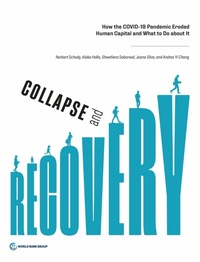
The COVID-19 pandemic has dealt a severe blow to human capital. This report presents new evidence and analysis to provide a comprehensive diagnostic of the effects of the pandemic on human capital outcomes and identify promising policy responses for governments faced with the task of rebuilding human capital in the wake of the pandemic. The report identifies the mechanisms through which COVID-19 affected the human capital of people at different points in the life cycle and provides estimates of the magnitude of these losses. This analysis underlines differences in impact across countries and groups within countries to understand how the reported blow on human capital has been unequal, exacerbating existing gaps and creating new ones. Grounded in the diagnostic, the report discusses policy responses that attend to afflicted groups in the short-term as well as the medium- to long-term agenda to build back better human capital and make systems more resilient. The long-term policy discussion recognizes COVID-19 as an inflection point, using the opportunity to reimagine systems and institutions, thinking in a completely different way about some key issues. In conclusion, the report reflects on what we have learned from failed policy responses as well as the innovations that proved successful across sectors in preventing or mitigating human capital losses associated with the COVID-19 crisis, and how these lessons can be incorporated across sectors going forward.
Language
Place of publication
Target group
Professional and scholarly
Edition type
Product notice
Paperback (trade)
Unsewn / adhesive bound
Dimensions
Height: 267 mm
Width: 203 mm
Thickness: 12 mm
Weight
ISBN-13
978-1-4648-1901-8 (9781464819018)
Copyright in bibliographic data and cover images is held by Nielsen Book Services Limited or by the publishers or by their respective licensors: all rights reserved.
Schweitzer Classification
The World Bank came into formal existence in 1945 following the international ratification of the Bretton Woods agreements. It is a vital source of financial and technical assistance to developing countries around the world. The organization's activities are focused on education, health, agriculture and rural development, environmental protection, establishing and enforcing regulations, infrastructure development, governance and legal institutions development. The World Bank is made up of two unique development institutions owned by its 185 Member Countries. The International Bank for Reconstruction and Development (IBRD) focuses on middle income and creditworthy poor countries and the International Development Association (IDA), which focuses on the poorest countries in the world.