

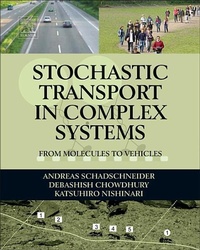
Stochastic Transport in Complex Systems
From Molecules to Vehicles
Published on 1. October 2010
Book
Paperback/Softback
582 pages
978-0-444-56216-6 (ISBN)
Description
The first part of the book provides a pedagogical introduction to the physics of complex systems driven far from equilibrium. In this part we discuss the basic concepts and theoretical techniques which are commonly used to study classical stochastic transport in systems of interacting driven particles. The analytical techniques include mean-field theories, matrix product ansatz, renormalization group, etc. and the numerical methods are mostly based on computer simulations. In the second part of the book these concepts and techniques are applied not only to vehicular traffic but also to transport and traffic-like phenomena in living systems ranging from collective movements of social insects (for example, ants) on trails to intracellular molecular motor transport. These demonstrate the conceptual unity of the fundamental principles underlying the apparent diversity of the systems and the utility of the theoretical toolbox of non-equilibrium statistical mechanics in interdisciplinary research far beyond the traditional disciplinary boundaries of physics.
Reviews / Votes
"The book is devoted to traffic and traffic-like collective phenomena. It starts with an overview of the basic techniques of modeling in the language of nonequilibrium statistical mechanics and nonlinear dynamics of interacting particles and fluids. Especially the traffic-like systems which are considered in the present book are mainly concerned with purely classical transport phenomena and quantum mechanics doesn't play any role in these processes. In Chapter one, a classification of nonequilibrium phenomena is given, as well as a hierarchy of description. The authors distinguish the models into two categories, the individual based models and the population based models... The book gives a well balanced overview of different approaches, theories and methods on a variety of problems both old and new, of international interest. It is of particular interest as a reference for both graduate courses and seminars as well as for library collections." --Zentralblatt Math"The book is encyclopaedic and contains a lot of information which might be very useful for graduate students and researchers new to the field... One can use it to learn the fundamentals of nonequilibrium statistical mechanics and stochastic processes, or to learn about many fundamental conceptual models and ideas, including numerical methods and algorithms that no doubt go beyond the applications considered in the second part of the book.... Finally, the book ends with an excellent guide to the literature, which points out and explains the main references, lest the reader be lost in the forest of the bibliography. The latter contains more than 1500 references, and is no doubt very complete.... The encyclopaedic character of this monograph, containing much useful information concerning techniques, methods, and models of traffic phenomena at large, makes it an important reference for young researchers and interested graduate students, as well as other scientists interested in the methods and techniques useful for applications in complex systems sciences." --Contemporary Physics
More details
Language
English
Place of publication
Oxford
United Kingdom
Publishing group
Elsevier Science & Technology
Target group
Professional and scholarly
Graduate students or professionals in theoretical physicists (particularly statistical physicists), engineering (particularly traffic engineers) and biological physicists (particularly in molecular cell biology and social insects).
Product notice
Paperback (trade)
Unsewn / adhesive bound
Dimensions
Height: 234 mm
Width: 188 mm
Thickness: 38 mm
Weight
1247 gr
ISBN-13
978-0-444-56216-6 (9780444562166)
Copyright in bibliographic data and cover images is held by Nielsen Book Services Limited or by the publishers or by their respective licensors: all rights reserved.
Schweitzer Classification
Other editions
Additional editions
Andreas Schadschneider | Debashish Chowdhury | Katsuhiro Nishinari
Stochastic Transport in Complex Systems
From Molecules to Vehicles
Book
10/2010
Elsevier
€158.46
Withdrawn from sale
Andreas Schadschneider | Debashish Chowdhury | Katsuhiro Nishinari
Stochastic Transport in Complex Systems
From Molecules to Vehicles
E-Book
10/2010
Elsevier
€137.00
Available for download
Persons
Dr. Andreas Schadschneider is Professor at the Institute for Theoretical Physics at the University of Cologne. His research covers various aspects of condensed matter physics ranging from solid state physics to interdisciplinary problems in statistical and biological physics. He has published more than hundred research papers in leading international journals. Dr. Debashish Chowdhury is a Professor of Physics at the Indian Institute of Technology Kanpur. He works on interdisciplinary topics in statistical and biological physics. He has published three books and more than hundred research papers in leading international journals. He is a fellow of the Indian Academy of Sciences. Dr. Katsuhiro Nishinari is an Associate Professor of Faculty of Engineering, University of Tokyo. He works on interdisciplinary topics in applied mathematics, fluid dynamics, and statistical physics. He has published more than fifty research papers in leading international journals.
Content
I. Methods and Concepts1. Introduction to Nonequilibrium Systems and Transport Phenomena2. Methods for the Description of Stochastic Models3. Particle-Hopping Models of Transport far From Equilibrium4. Asymmetric Simple Exclusion Process - Exact Results
II. Applications5. Vehicular Traffic I: Empirical Facts6. Vehicular Traffic II: The Nagel-Schreckenberg Model7. Vehicular Traffic III: Other CA Models8. Vehicular Traffic III: Non-CA Modelling Approaches9. Transport on Networks10. Pedestrian Dynamics11. Biological Traffic
II. Applications5. Vehicular Traffic I: Empirical Facts6. Vehicular Traffic II: The Nagel-Schreckenberg Model7. Vehicular Traffic III: Other CA Models8. Vehicular Traffic III: Non-CA Modelling Approaches9. Transport on Networks10. Pedestrian Dynamics11. Biological Traffic